Energy Flow in an Ecosystem Class 9 Science Chapter 7 Questions And Answers Maharashtra Board
17 February 2026 EasyLearning
1. Complete the following table (Carefully study the carbon, oxygen and nitrogen cycles).

Answer.
| Bio-geo-chemical cycles | Biotic processes | Abiotic processes |
| 1. Carbon cycle | Photosynthesis, Respiration, Decomposition | Combustion (burning fuels), Weathering of rocks, Volcanic eruptions |
| 2. Oxygen cycle | Photosynthesis (production), Respiration (consumption) | Oxidation (rusting), Formation of ozone, Combustion |
| 3. Nitrogen cycle | Biological Nitrogen Fixation, Nitrification, Denitrification | Atmospheric Nitrogen Fixation (Lightning), Industrial Fixation (Haber process) |

2. Correct and rewrite the following statements and justify your corrections.
a. Carnivores occupy the second trophic level in the food chain.
Answer.
Correction : Carnivores occupy the third trophic level. Autotrophic producers constitute the first trophic level. Herbivorous animals obtain their nutrients from them. They occupy second trophic level. Carnivorous animals feed upon these herbivorous animals, therefore, they occupy the third trophic level in the food chain.
b. The flow of nutrients in an ecosystem is considered to be a ‘one way’ transport.
Answer.
Correction : The flow of nutrients in an ecosystem is considered to be cyclic. The green plants are producers. By photosynthesis they convert minerals and inorganic compounds into glucose. This food is transferred along with food chain from producers -> primary consumers -> secondary consumers. The decomposers of the ecosystem decompose all the dead and decaying organisms and return these nutrients back to the ecosystem. Thus, the flow of nutrients is cyclic and not one way transport.
c. Plants in an ecosystem are called primary consumers.
Answer.
Correction : Plants in an ecosystem are producers. Green plants are called producers as they carry out photosynthesis with the help of solar energy. The food which they produce is utilized by the herbivores. Therefore, they are called producers. Herbivores are primary consumers.
3. Give reasons.
a. Energy flow through an ecosystem is ‘one way’.
Answer.
(1) Sun is the ultimate source of energy.
(2) In all ecosystems, producers ( green plants ) store the solar energy in the form of food.
(3) This energy is passed on from one trophic level to the other trophic level.
(4) Owing to decomposition some part of this energy is released in the form of heat.
(5) However no part of energy returns to the sun. Therefore, energy flow through an ecosystem is one way.
b. Equilibrium is necessary in the various bio-geo-chemical cycles.
Answer.
(1) In nature, the various bio-geochemical cycles operate simultaneously and there is an equilibrium between them.
(2) During these cycles, the inorganic compounds that are released from organic compounds are released back to nature.
(3) Soil bacteria and other decomposers play a vital role in these cycles.
(4) If bio-geochemical cycles are imbalanced then they bring about the imbalance in the ecosystem as a result of which the ecosystem is destroyed. This shows that equilibrium is necessary in the various bio-geochemical cycles.
c. Flow of nutrients through an ecosystem is cyclic.
Answer.
(1) Producers obtain nutrients from the soil, and CO2 from the atmosphere and synthesis food from them with the help of photosynthesis.
(2) During this process, the inorganic substances are converted into organic substances.
(3) Consumers consume the food produced by producers. The energy in the form of food is thus passed on from one trophic level to the other trophic level.
(4) Both producers and consumers after their death undergo decomposition and after decomposition the nutrients released from them mix with the soil. In the same way, the excreta of animals undergo decomposition and release nutrients to the environments. Thus, we see that the flow of nutrients in the ecosystem follows a cyclic path.
4. Explain the following cycles in your own words with suitable diagrams.
a. Carbon cycle.
Answer.
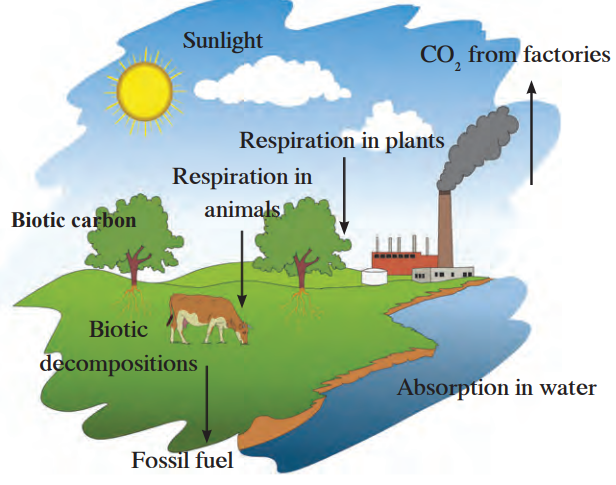
- The circulation and recycling of carbon from the atmosphere to living organisms and after their death back to the atmosphere is called the carbon cycle.
- Abiotic carbon atoms are circulated and recycled into biotic form mainly through photosynthesis and respiration.
- Hence, the carbon cycle is one of the important bio-geochemical cycles.
- Plants convert carbon dioxide into carbohydrates by the process of photosynthesis.
- Similarly, they produce carbon compounds like proteins and fats, too.
- Carnivores feed upon herbivores. In this way, biotic carbon is transported from plants to herbivores, from herbivores to carnivores and from carnivores to apex consumers.
- Eventually, after death, all types of consumers, are decomposed by decomposers like bacteria and fungi and carbon dioxide is released again into the atmosphere and is used again by living organisms.
- In this way, carbon is continuously passed on from one living organism to another. After the death of living organisms, carbon goes to the atmosphere and is again taken up by living organisms.
b. Nitrogen cycle.
Answer.
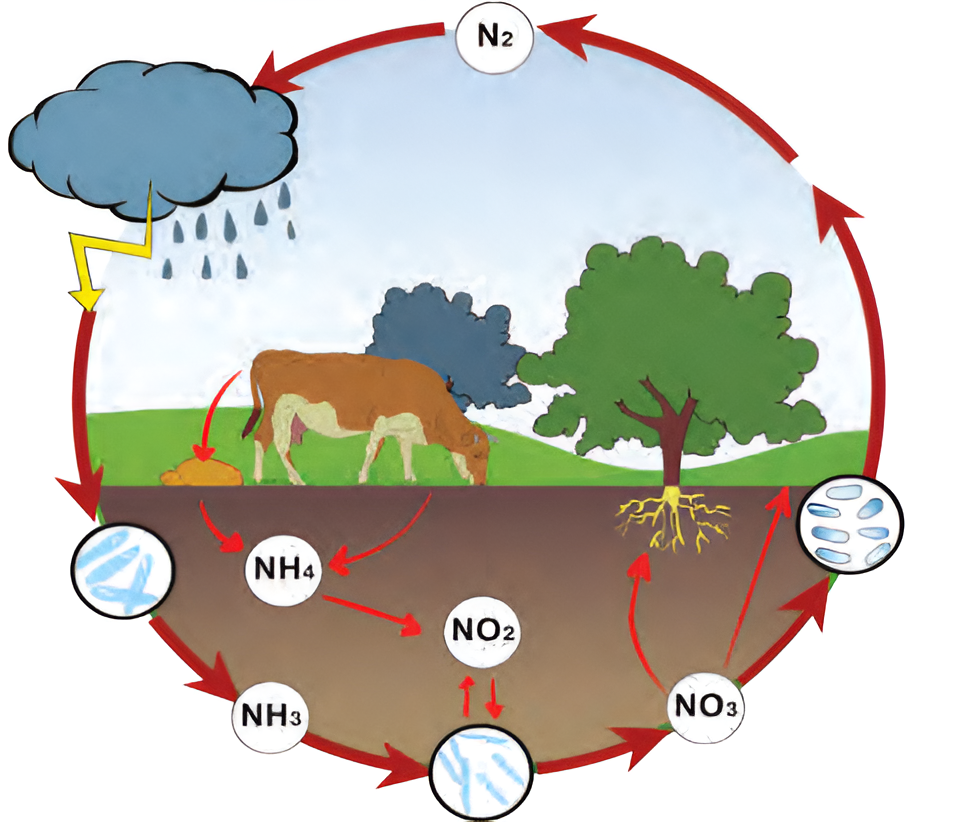
- Nitrogen forms 78% i.e. the maximum portion of the atmosphere. It is necessary for the maintenance of the cycle of nature.
- The circulation and recycling of nitrogen gas into the form of different compounds through various biotic and abiotic processes in nature is called the nitrogen cycle.
- All organisms participate in the nitrogen cycle. It is an important component of proteins and nucleic acids.
- As compared to other elements, it is inactive and does not easily combine with other elements. Most organisms cannot use the free form of nitrogen.
- Important processes of nitrogen cycle:
(a) Nitrogen fixation: Conversion of nitrogen into nitrates and nitrites through atmosphere, industrial and biological processes.
(b) Ammonification: Release of ammonia through the decomposition of dead bodies and excretory wastes of organisms.
(c) Nitrification: Conversion of ammonia into a nitrite and then nitrate.
(d) Denitrification: Conversion of nitrogen compounds into gaseous nitrogen.
c. Oxygen cycle.
Answer.
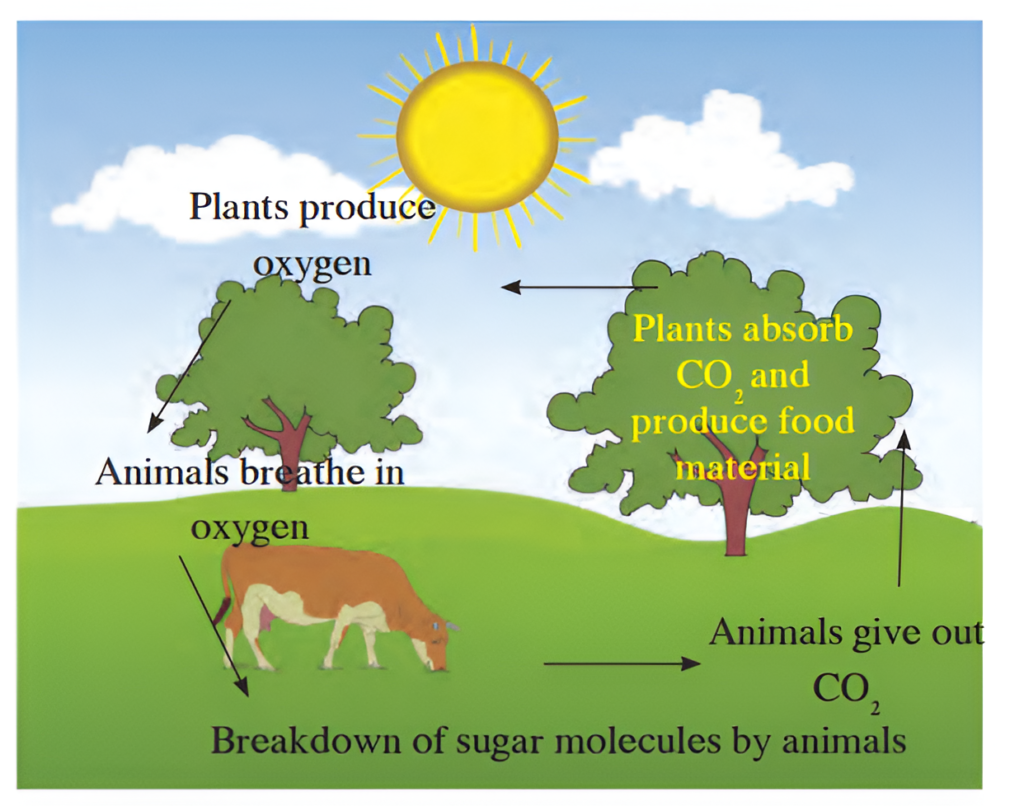
- Oxygen forms 21% of the atmosphere. It is also present in the hydrosphere and lithosphere. The circulation and recycling of oxygen within the biosphere is called the oxygen cycle.
- This cycle, includes both the biotic and abiotic components. Oxygen is continuously produced as well as used up in the atmosphere.
- Oxygen is highly reactive and it readily reacts with other elements and compounds.
- As oxygen is found in various forms like molecular oxygen (O2), water (H2O), carbon dioxide (CO2), inorganic compounds etc, the oxygen cycle of the biosphere is extremely complex.
- Oxygen is released in the process of photosynthesis, whereas it is used up in processes like respiration, combustion, decomposition, corrosion, rusting, etc.
5. What would you do to help maintain the equilibrium in the various bio-geo-chemical cycles? Explain in brief.
Answer.
- Bio-geo-chemical cycles always involve the achievement of equilibrium, i.e., a balance in the cycling of the nutrients between the spheres.
- Human activities that are known to be environmentally unfriendly can disrupt this balance.
- We should avoid deforestation as trees play an important role in maintaining the balance.
- We should avoid overuse of fertilizers. The fertilizers get washed away in the nearby water bodies disrupting the balance.
- Avoid burning of fossil fuels as these fuels release a large amount of carbon in the form of carbondioxide, thus disrupting the balance.
- Vehicular emissions is another contributor to the disruption in balance of the various cycles.
- These emissions release oxides of nitrogen and carbon and other hazardous air pollutants.
- So, we must use better quality fuel like CNG or ethanol to reduce vehicular emissions.
6. Explain in detail the inter-relationship between the food chain and food web.
Answer.
- Interaction go on continuously between producers, consumers and decomposers.
- There is a definite sequence in these interactions which is called the food chain.
- Each chain consists of four, five or more links.
- An ecosystem consists of many food chains that are interconnected at various levels. Thus, a food web is formed.
- An organism may be the prey for many other organisms.
- For example, an insect feeds upon leaves of various plants but the same insect is the prey for different animals like frog, wall lizard, birds, etc.
- Thus, many food chains interconnected together form an intricate web called as food web.
7. State the different types of bio-geochemical cycles and explain the importance of those cycles.
Answer.
- The different types of bio-geo-chemical cycles are nitrogen, oxygen, carbon, water vapour, iron, calcium, phosphorus, etc.
- Nutrients, necessary for the growth of the organisms are continuously transferred from abiotic to biotic factors and biotic to abiotic factors within an ecosystem.
- These cycles operate continuously through the medium of the biosphere formed by the lithosphere, atmosphere and hydrosphere.
- The recycling of biological, geological and chemical sources of nutrients takes place through these cycles.
- Nutrients from the biosphere enter the bodies of plants and animals. Eventually, after death, all types of consumers are decomposed by decomposers like bacteria and fungi and they are again released into the biosphere and are used again by living organisms.
- Therefore, these cycles help in maintaining the flow of nutrients and energy through ecosystem and maintaining the equilibrium in the ecosystem.
8. Explain the following with suitable examples.
a. What type of changes occur in the amount of energy during its transfer from plants to apex consumers ?
Answer.
- Plants of the ecosystem store some of the solar energy in the form of food.
- Before reaching the decomposers, this energy is passed on from one trophic level to the next.
- At every trophic level, some amount of energy is used by the organism for its own life processes and some amount of energy is lost to the surroundings.
- Decomposers dissipate some amount of energy in the form of heat.
- However, no part of the energy ever returns to the Sun. Hence, such passage of energy is referred to as ‘one way’ transport.
- Therefore, energy is maximum at the base of the pyramid and is least at the apex, e.g.
- phytoplanktons which form the base of the pyramid have 10,000 kcal of energy while humans at the apex have 10 kcal of energy.
b. What are the differences between flow of matter and of energy in an ecosystem ? Why ?
Answer.
| Flow of matter | Flow of energy |
| (i) It involves the circulation and recycling of nutrients in a cyclic manner within the biosphere. | (i) It involves the flow of energy from one trophic level to another in a unidirectional or non-cyclic manner. |
| (ii) There is no dissipation of matter at any level. | (ii) There is the dissipation of energy at every level. |
| (iii) Biosphere is the source of nutrients. | (iii) The Sun is the most important source of energy. |