The United Nations (UN) Class 9 Political Science Chapter 4 Questions And Answers Maharashtra Board
24 March 2026 EasyLearning
1. Choose the correct option from the given options and complete the statements.
(1) This country is not a permanent member of United Nations Security Council –
(a) America (b) Russia
(c) Germany (d) China
Answer.
(c) Germany
(2) This international organisation conducts workshops in India on remedial measures to tackle the problem of malnutrition among children –
(a) UNICEF (b) UNESCO
(c) Trusteeship Council (d) Redcross
Answer.
(a) UNICEF
(3) The number of members of the United Nations –
(a) 190 (b) 193
(c) 198 (d) 199
Answer.
(b) 193

2. State whether the following statements are true or false. Give reasons for your answer.
(1) The United Nations General Assembly is a platform to discuss global problems.
Answer.
True.
- Every year the General Assembly meets in its session. During the session, the General Assembly discusses important issues like environment, disarmament, etc.
- The significance of the General Assembly lies in it being a platform for representatives of member nations to come together and discuss and make policy decisions on issues of global importance.
(2) The status of all the member nations of the United Nations is not equal.
Answer.
Answer:
False.
- As mentioned in the principles of UN, all member nations have the same status.
- There is no discrimination among nations based on geographical size, economic or military power.
(3) A resolution can be passed even if China exercises its veto power.
Answer.
False
- China is one of the five permanent members of the UN and the permanent members have veto power.
- If even one of the five permanent members uses it’s veto i.e. gives a negative vote, the decision cannot be taken.
(4) India has played a major role in the work of the United Nations.
Answer.
True.
- India has always sent her troops to participate in the United Nations peacekeeping forces.
- India has participated in bringing issues like decolonisation, disarmament, racial segregation on the United Nations platform.
3. Explain the following concepts.
(1) Veto
Answer.
(i) Security Council has 5 permanent members and 10 non-permanent members.
(ii) For any decision to be taken, the assent of all five permanent members and four non-permanent members is necessary.
(iii) America, Russia, England, France and China are permanent members of the Security Council. They have the veto power.
(iv) If even one of the five permanent member uses its veto i.e. gives a negative vote, the decision cannot be taken
(2) UNICEF
Answer.
(i) UNICEF is an affiliated organisation of the United Nations.
(ii) It works towards making nutritious food and health care available to children.
(iii) Several workshops were organised in India to find out measures to overcome malnutrition among babies and children.
4. Answer in brief.
(1) Write the reasons for the establishment of the United Nations.
Answer.
The United Nations is the world’s largest international organisation. The reasons for the establishment of the United Nations are:
(i) Two World Wars were fought at the beginning of the twentieth century.
(ii) Life and property were destroyed on a large scale in these wars.
(iii) As a result, the League of Nations was established after the First World War and the United Nations was established after the Second World War out of a realisation that there has to be a mechanism to establish world peace.
(iv) The League of Nations did not succeed at all.
(v) But after the use of the nuclear weapons in the . Second World War, the idea took root that such destructive wars should be stopped and that it is the collective responsibility of all nations to do so.
(vi) The United Nations was established after the Second World War to instill this understanding among all nations.
(vii) Hence, the United Nations, an international organisation was established to ensure peace and security at the international level.
(2) What is the role of the Peacekeeping Forces of the United Nations.
Answer.
(i) The peacekeeping activity of the United Nations involves creating appropriate circumstances favourable for bringing about permanent peace in strife-tom areas.
(ii) The peacekeeping forces help these areas to progress towards peace.
(iii) In conflict ridden areas, security is provided and at the same time, help is extended for establishing peace.
(iv) The United Nations takes up peacekeeping as one of the tasks for safeguarding and fostering peace in the world.
(3) Write the objectives of the United Nations.
Answer.
The United Nations has its own definite objectives. They are as follows:
- To establish friendly relations among nations.
- To enhance international security by solving international disputes.
- To safeguard and foster human rights and freedom.
- Along with these, the United Nations also aim at enhancing economic cooperation at the international level.
5. Complete the following activity as per the given instructions.
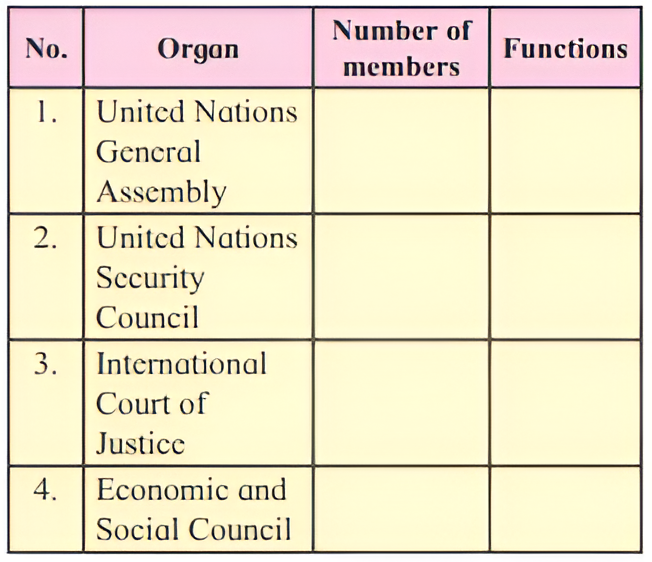
(1) Complete the following chart giving information about the organs of the United Nations.
Answer.
| S.No. | Organ | Number of members | Functions |
| (1) | United Nations General Assembly | 193 | (1) To elect the non-permanent members of the Security Council. (2) To choose the United Nations Secretary General and the judges of the International Court of Justice (ICJ) in consultation with the Security Council. (3) To pass the annual budget of the United Nations. |
| (2) | United Nations Security Council | 15(5 Permanent and 10 NonPermanent) | (1) To maintain international peace and security. (2) To prepare policies for arms control. (3) To play a joint role along with the General Assembly in the appointments of the judges of the International Court of Justice and of the United Nations Secretary General. |
| (3) | International Court of Justice | 15 judges | (1) To settle the disputes between two or more member nations of the United Nations. (2) To interpret international law authentically. (3) To advise the various organs or subsidiary bodies of the United Nations about legal issues. |
| (4) | Economic and Social Council | 54 members | (1) Initiate discussions at the global level on issues like poverty, unemployment, economic and social inequality and suggest policies to tackle these problems. (2) Discuss issues like women’s questions, empowerment of women, human rights, fundamental freedoms, global trade, health related issues, etc., and make decisions. (3) Make efforts to establish cultural and educational cooperation at the international level. (4) Coordinate the functioning of the different organisations working in association with the United Nations. |
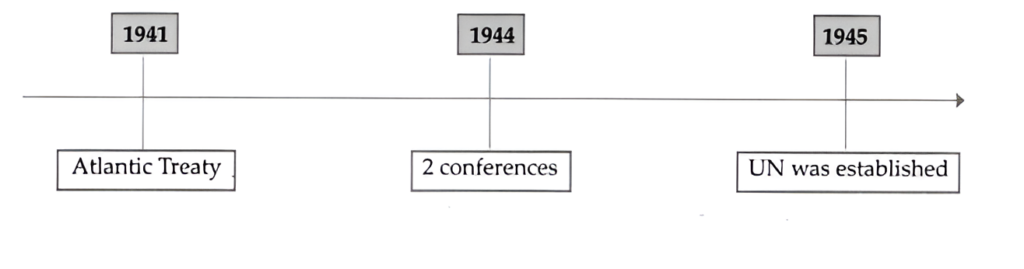
(2) Show the chronology of the establishment of the United Nations.
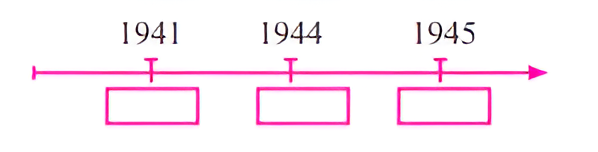
Answer.
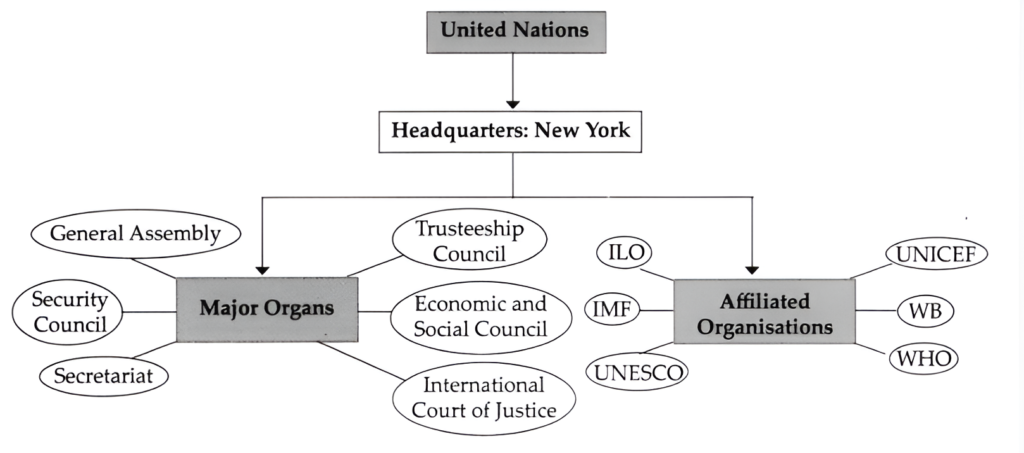
(3) Complete the following tree diagram about the United Nations.
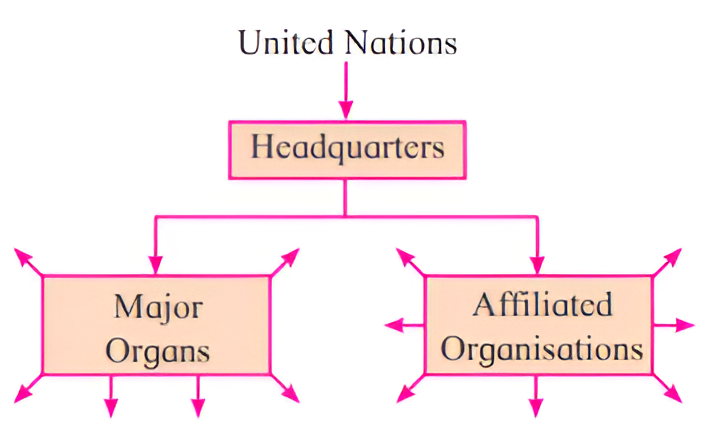
Answer.