International Date Line Class 9 Geography Chapter 7 Questions And Answers Maharashtra Board
28 March 2026 EasyLearning

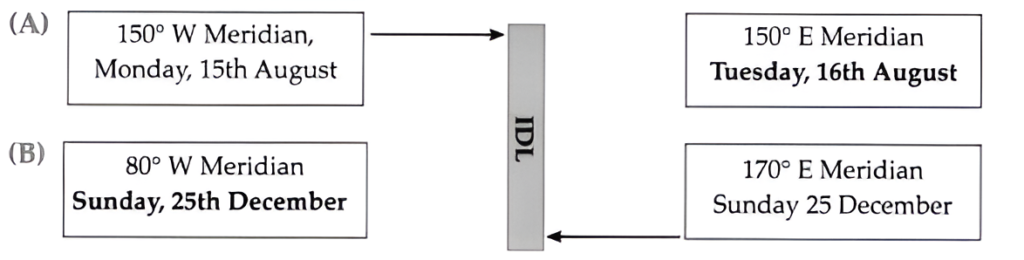
1. Two boxes in different hemispheres are given in the following diagram. The IDL passes through both the boxes. In one box, the meridian, day and date is given. Find the day and date for the other box.
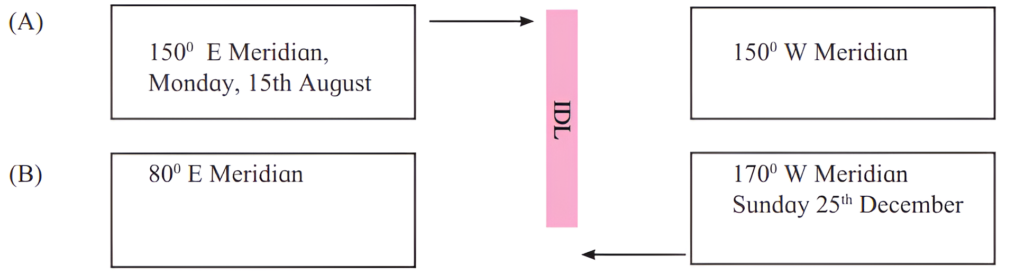
Answer.

2. Select the correct option :
(1) While crossing the IDL, a person will have to add one day when travelling from
(a) East to West
(b) West to East
(c) South to North
(d) North to South
Answer.
(a) East to West
(2) If it is Wednesday 10 a.m. at 15° E meridian, then what will be the time at IDL?
(a) Wednesday 6 a.m.
(b) Wednesday 9 p.m.
(c) Thursday 2 p.m.
(d) Thursday 6 p.m
Answer.
(b) Wednesday 9 p.m.
(3) According to the international convention, at which meridian does the day and date change occurs?
(a) 0°
(b) 90° E
(c) 90° W
(d) 180°
Answer.
(d) 180°
(4) At which direction of the IDL does a new day start immediately?
(a) East
(b) West
(c) North
(d) South
Answer.
(b) West
(5) IDL brings coordination in which of the following?
(a) GPS system
(b) Defence departments
(c) Transportation schedules
(d) Determining the hemisphere
Answer.
(c) Transportation schedules
3. Give geographical reasons.
(1) IDL is proving to be very useful in today’s times.
Answer.
IDL is proving to be very useful in today’s times because:
- The IDL brings coordination between international airlines, transportation services, economic and trade activities.
- The IDL has been carved out of the necessity of coordinating time and date.
- It is also important in today’s modern era and rapidly happening global developments.
- We can keep a track of all the calculations of a day and time accurately with the help of IDL in case of global transportation especially, with respect to airways.
- It is only because of the IDL that the schedules of the traffic worldwide are organised properly.
(2) The day starts in Pacific Ocean on the earth.
Answer.
- The IDL passes through the Pacific Ocean.
- With reference to the IDL, the day on Earth starts in the West and ends in the East.
- It is one and the same day only at 12 o’clock midnight at the 180° meridian.
- For the countries lying to the east of it i.e. the USA, Chile, etc., it is the end of the day while for the countries lying to the west of it i.e. Japan, Australia, etc. it is the start of a new day.
4. Write in brief:
(1) What considerations have been made while deciding the IDL?
Answer.
The following points were taken into consideration while drawing the International Date Line. (IDL):
1. The direction of travel
2. The current day and date
- Accordingly, while traveling from East to West of IDL, a day is added. For example, while travelling from America to Japan, if it is Thursday 25th December, then it will be Friday 26th December in Japan.
- While from West to East of IDL, the day remains the same. For example, while travelling from Japan to America, if it is Thursday 25th December, then Thursday 25th December, only should be considered.
(2) While crossing the IDL, what changes will you make?
Answer.
- When you cross the 180° meridian, some precautions need to be taken.
- There is a difference of 12 hours from Prime Meridian, if you go from East or West.
- According to the convention, the start (and end) of a date is considered to be at 180° Meridian.
- Accordingly, an adjustment or change in day and time is made. Thus, while travelling from east to west of IDL , a day is added whereas while travelling from west to east of IDL, the day remains the same.
(3) Why is the IDL not a straight line like the 180° meridian?
Answer.
- Attempt has been made to make the IDL pass through the Pacific Ocean completely.
- Had it passed through a land or some islands, the people there would have had to follow different dates and timings because dates would have been different on their Eastern and Western parts.
- Also, it would have been difficult to know when one crosses the IDL on land, and when the date changes on the calendar.
- Therefore, the IDL is not a straight line like the 180° Meridian. At places, it turns East while at other places, it turns West.
(4) Why doesn’t the IDL pass through land?
Answer.
- If the IDL had passed through a land or some islands, the people there would have had to follow different dates and timings because dates would have been different on their Eastern and Western parts.
- Also, it would have been difficult to know when one crosses the IDL on land and when the date changes on the calendar.
- Hence, the IDL does not pass through land
(5) Why is the IDL considered with respect to the 180° meridian only?
Answer.
- Our 24-hour day starts at 12 midnight. Because of the earth’s rotation, the midnight occurs at different times, at different places.
- As the Earth is spherical in shape, every place has a place to its East.
- So, it was necessary to determine at what location to the East does the day start on Earth.
- Hence, representatives of many nations got together, under the leadership of an American Professor, Davidson, in the year 1884 and decided the International Date Line.
- The line was drawn opposite to the Greenwich Prime Meridian i.e. with reference to the 180° Meridian.
5. Using an atlas, tell in which of the following routes the IDL will be crossed and show them on the map.
(1) Mumbai- London- New York- Los Angeles- Tokyo
(2) Delhi- Kolkata- Singapore- Melbourne
(3) Kolkata- Hong Kong- Tokyo- San Francisco
(4) Chennai-Singapore- Tokyo- Sydney- Santiago
(5) Delhi-London-New York
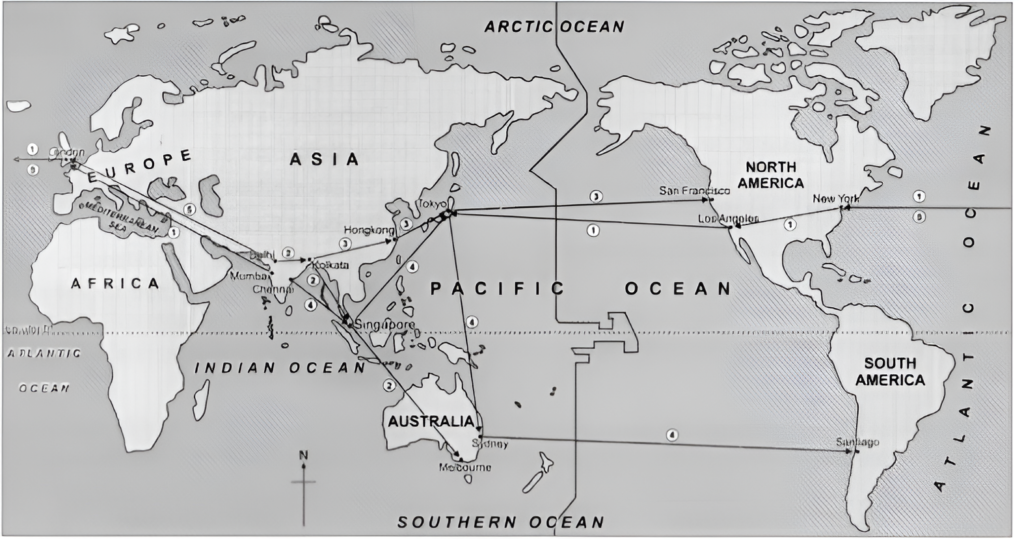
Answer.
(1) Mumbai – London – New York – Los Angeles – Tokyo – IDL will be crossed.
(2) Delhi – Kolkata – Singapore – Melbourne – IDL will not be crossed
(3) Kolkata – Hong Kong – Tokyo – San Fransico – IDL will be crossed.
(4) Chennai – Singapore – Tokyo – Sydney – Santiago – IDL will be crossed
(5) Delhi – London – New York – IDL will not be crossed.