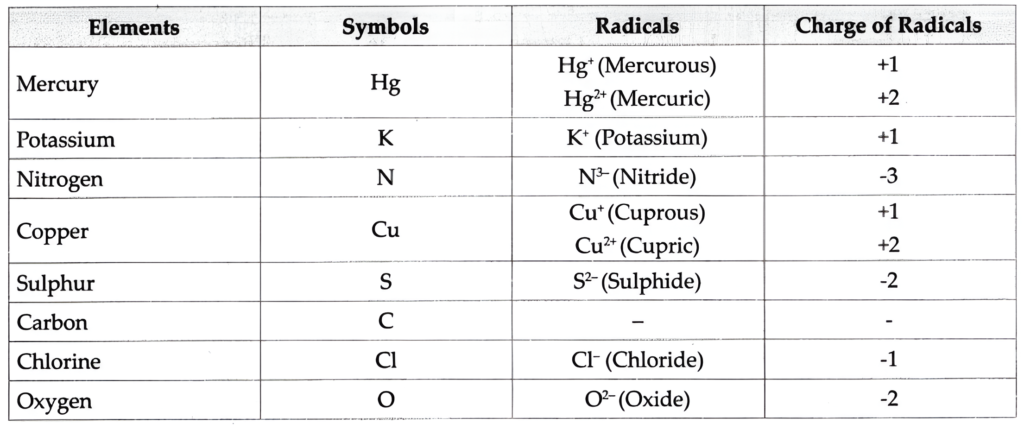
2. Write symbols of the following elements and the radicals obtained from them, and indicate the charge on the radicals. ( Mercury, potassium, nitrogen, copper, sulphur, carbon, chlorine, oxygen)
Answer.
3. Write the steps in deducing the chemical formulae of the following compounds. ( Sodium sulphate, potassium nitrate, ferric phosphate, calcium oxide, aluminium hydroxide )
4. Write answers to the following questions and explain your answers.
a. Explain the monovalency of the element sodium.
Answer.
The number of protons or electrons (atomic number) in Sodium (Na) atom is 11. Therefore the electronic configuration of sodium atom is (2, 8,1).
In chemical reaction, sodium atom has the capacity to give away le_ from its outermost orbit to form Na+ ion with stable electronic configuration (2, 8).
As sodium atom gives away le- and a cation of sodium is formed, hence the valency of sodium is 1 and therefore, the element sodium is monovalent.
b. M is a bivalent metal. Write down the steps to find the chemical formulae of its compounds formed with the radicals : sulphate and phosphate
Answer.
Given: Metal M is bivalent (Valency = 2).
1. Compound with Sulphate Radical
The radical for Sulphate is SO4 with a valency of 2.
Symbol
M
SO4
Valency
2
2
Step: Since both valencies are 2, we simplify the ratio to 1:1.
Final Formula: MSO4
2. Compound with Phosphate Radical
The radical for Phosphate is PO4 with a valency of 3.
Symbol
M
PO4
Valency
2
3
Step: We criss-cross the valencies. The 3 goes to M and the 2 goes to the whole Phosphate group.
[Image of valency criss-cross method for M3(PO4)2]
Final Formula: M3(PO4)2
c. Explain the need for a reference atom for atomic mass. Give some information about two reference atoms.
Answer.
The mass of an atom is concentrated in its nucleus and it is due to the protons (p) and neutrons (n) in it.
Since an atom is very very tiny, it was not possible to measure atomic mass accurately. Therefore, the concept of relative mass of an atom was formed.
To express relative mass of an atom, reference of atom is considered. The two reference atoms were as follows:
(a) Hydrogen (H) atom: The hydrogen atom is the lightest. The relative mass of a hydrogen atom is 1 which has only 1 proton in its nucleus. On this scale, the relative atomic mass of many elements comes out to be fractional. Therefore, carbon was selected as a reference atom.
(b) Carbon(C) atom: The carbon atom is selected as reference atom. In this scale, the relative mass of a carbon atom is accepted as 12.
The relative atomic mass of 1 hydrogen (H) atom compared to the carbon (C) atom becomes
d. What is meant by Unified Atomic Mass?
Answer.
During earlier time, relative mass of an atom was considered for measuring the mass of an atom directly. But since the founding of unified mass, relative mass is not accepted henceforth.
Unified atomic mass is the unit of atomic mass called as Dalton.
Its symbol is ‘u’. lu = 1.66053904 x 10⁻²⁷ kg.
e. Explain with examples what is meant by a ‘mole’ of a substance.
Answer.
A mole is that quantity of a substance whose mass in grams is equal in magnitude to the molecular mass of that substance in Daltons.
For example: Atomic mass of oxygen atom (O) is 16u. Thus, the molecular mass of oxygen molecule (O2) is 16 x 2 = 32u. Therefore, 32 g of oxygen is 1 mole of oxygen.
NEW SYLLABUS
Class 9 Science
Maharashtra Board Textbook Solutions
Ab har sawaal hoga aasaan! Get step-by-step exercise answers for all 18 chapters for English Medium & Semi-English Medium.
6. Two samples ‘m’ and ‘n’ of slaked lime were obtained from two different reactions. The details about their composition are as follows:
‘sample m’ mass : 7g Mass of constituent oxygen : 2g Mass of constituent calcium : 5g ‘sample n’ mass : 1.4g Mass of constituent oxygen : 0.4g Mass of constituent calcium : 1.0g
Which law of chemical combination does this prove? Explain.
Answer.
(i) The expected proportion by weight of the constituent elements of quick lime that is calcium oxide would be from its known molecular formula CaO. The atomic mass of Ca and O are 40 and 16 respectively. This means, the proportion by weight of the constituent elements Ca and O in the compound CaO is 40 :16 which is 5 : 2.
(ii) Now, for the given sample’m’ of CaO = 5 g mass of given sample = 7 g mass of constituent Ca in sample’m’ = 5 g mass of constituent O in sample’m’ = 2 g
(iii) This means that 7 g of calcium oxide contairis 5 g of calcium (Ca) and 2 g of oxygen (O); apd the proportion by weight of calcium and oxygen in it is 5 : 2.
(iv) Now, for the given sample ‘n’ of CaO mass of given sample CaO = 1.4 g Mass of constituent Ca in sample ‘n’ = 1.0 g Mass of constituent O in sample ‘n’ = 0.4 g This means that 1.4g of calcium oxide contains 1.0 g of calcium (Ca) and 0.4 g of oxygen (O); and the proportion by weight of calcium and oxygen in it is 5 : 2.
(v) Above samples’m’ and ‘n’ of calcium oxide (CaO) shows that the proportion by weight of the constituent elements in different samples of a compound is always constant that is the proportion by weight of calcium (Ca) and oxygen (O) in different samples of calcium oxide (CaO) is constant.
(vi) The experimental value of proportion by weight of the constituent elements matched with the expected proportion calculated by molecular mass. This proves and verifies the law of constant proportion.
The law states that ‘The proportion by weight of the constituent elements in the various samples of a compound is fixed’.
7. Deduce the number of molecules of the following compounds in the given quantities.