
1. Choose the correct option from the given options and complete the statements.
(i) India won the cricket world cup under the captainship of .
(a) Sunil Gavaskar (b) Kapil Dev (c) Sayyad Kirmani (d) Sandip Patil
Answer.
(b) Kapil Dev
(ii) The language is gaining importance in India due to the process of globalisation.
(a) Punjabi (b) French (c) English (d) Hindi
Answer.
(c) English

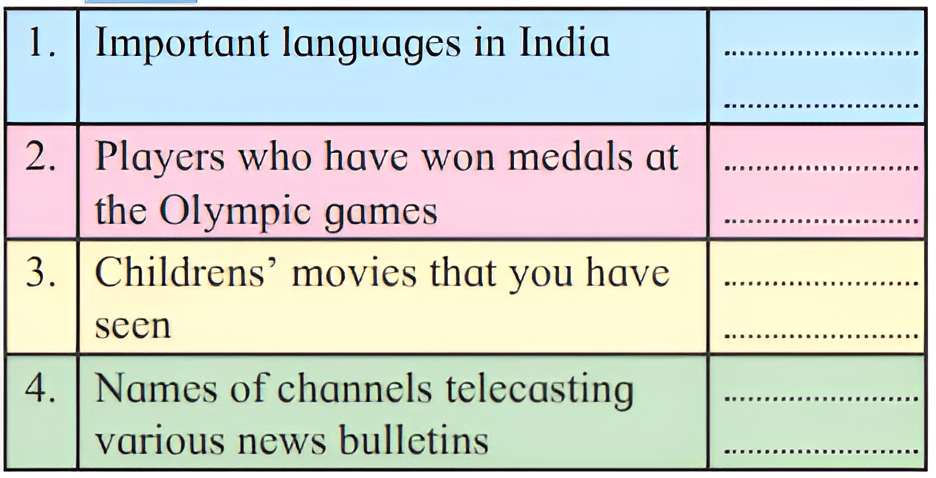
2. Complete the activity as per the given instructions. Complete the following table.
Answer.
| (1) | Important languages in India | Marathi, Hindi, Gujarati |
| (2) | Players who have won medals at the Olympic games | Karnam Malleswari, Abhinav Bindra, P.V. Sindhu |
| (3) | Childrens’ movies that you have seen | The Lion King, Minions, Finding Nemo etc. |
| (4) | Names of channels telecasting various news bulletins | DD News, CNN, ABP News |
3. Explain the following statements with reasons.
(1) Cricket began to be played all over India, to a greater or smaller extent.
Answer.
Cricket began to be played all over India, to a greater or smaller extent because:-
- In 1983, the Indian team won the World Cup for cricket, under the captainship of Kapil Dev. It was a historic victory.
- Cricket instantly won great popularity across the country.
- In the same year, Sunil Gavaskar broke the earlier record of maximum centuries in test cricket.
- In 1985, India won the ‘Benson and Hedges’ World Championship of cricket. As a result, cricket came to be played in all States to a lesser or greater extent, but at the cost of indigenous Indian games.
(2) The economy of movies is changing.
Answer.
(i) Movies in foreign languages are now translated. Even during the screening of English movies, a short Hindi translation now appears on the screen as sub-titles.
(ii) Hindi movies now compete with ‘global’ movies as they have reached every nook and comer of the world. We see a reflection of politics, social events, industry and technology in the movies.
(iii) Movies which were 3-4 hours long are now of only one or one and a half hours. Moreover, the concept of one screen and one cinema hall has given way to multiplexes.
(iv) The days of a movie running for 100 weeks in one cinema hall are over. Now one movie runs in thousands of cinema halls in India and abroad simultaneously.
(v) This development has changed the economy of movies. Production of movies has attained the status of industry.
(vi) The industry now employs crores of people. The movie industry in regional languages is also thriving.
Therefore the economy of movies is changing.
4. Answer the following questions in detail.
(1) Why is it necessary to keep alive the dialects of Indian languages?
Answer.
(i) Hindi, Assamese, Bengali, Gujarati, Kannad, Kashmiri, Malayalam, Marathi, Odiya, Punjabi, Sanskrit, Tamil, Telugu, Urdu, Konkani, Manipuri, Nepali and Sindhi are the official languages in India.
(ii) These Indian languages also have dialects, but their number is now on the decline.
(iii) Timely steps should be taken to nurture them, otherwise we will lose an important part of our heritage.
(iv) Nevertheless, Hindi, which has reached everywhere through the medium of Hindi movies, has served to unite the country by language.
(2) Elaborate upon the changing form of newspapers.
Answer.
(i) During early post-independence period, the newspapers were expected to not only give the news of daily events, but also give impetus to industry and commerce by printing advertisements.
(ii) Earlier, newspapers were black and white. With the changing times, colour printing became common.
(iii) Earlier, newspapers were thought to be the mouthpieces of the taluka or district. Now they have to face tough competition from the State level newspaper chains. But on the whole, newspapers are now becoming more active.
(iv) Their scope has enlarged to include raising funds for drought affected and flood affected people, helping meritorious students from lower income groups to go for higher education and organizing or sponsoring cultural programmes. This is how newspapers have now become an inseparable part of our lives.
(3) Which changes have taken place in the medium of television?
Answer.
(i) Television came to India during the post-independence period. Earlier it was black and white. Now it is coloured. Earlier it was limited to some selected programmes and fixed time-slots.
(ii) Gradually its scope was enlarged to include educational programmes, news bulletins, detailed reporting of the tours of the President and the Prime Minister.
(iii) During the telelcast of Ramayana and Mahabharat, a majority of the people used to sit glued to the television set. These serials proved the popularity of this medium. Then in 1991, CNN channel showed to the entire world a live visual reporting of the Iraq war.
(iv) In 1998, STAR (Satellite Television Asia Region) a private media house entered India, and the uninteresting, monotonous and propagandist news telecasts of the early period underwent a sea change.
(v) The language, the technique of presentation, studios equipped with the latest technology and the use of OB (outdoor broadcasting) vans have expanded the scope of Indian T.V. channels still further, and brought in transparency and variety. Now, every nook and corner of the country is connected.