Economic Development Class 9 History And Political Science Chapter 4 Questions And Answers Maharashtra Board
18 March 2026 EasyLearning
1. (A) Choose the correct option from the given options and complete the statements.
(1) On 19th July 1969 ………. major banks in India were nationalised.
(a) 12 (b) 14 (c) 16 (d) 18
Answer.
(b) 14
(2) …………… declared a 20 point programme.
(a) Pandit Nehru (b) Lal Bahadur Shastri (c) Indira Gandhi (d) P. V. Narsimha Rao
Answer.
(c) Indira Gandhi
(B) Identify and write the wrong pair.
(1) Kavasaji Davar – Iron and Steel factory
(2) Dr Datta Samant – Leadership of mill workers
(3) N. M. Lokhande – Holiday for mill workers
(4) Narayan Survey – Depiction of lives of workers through poems
Answer.
Wrong Pair : Kavasaji Davar – Iron and Steel factory.

2. Complete the activity as per given instruction.
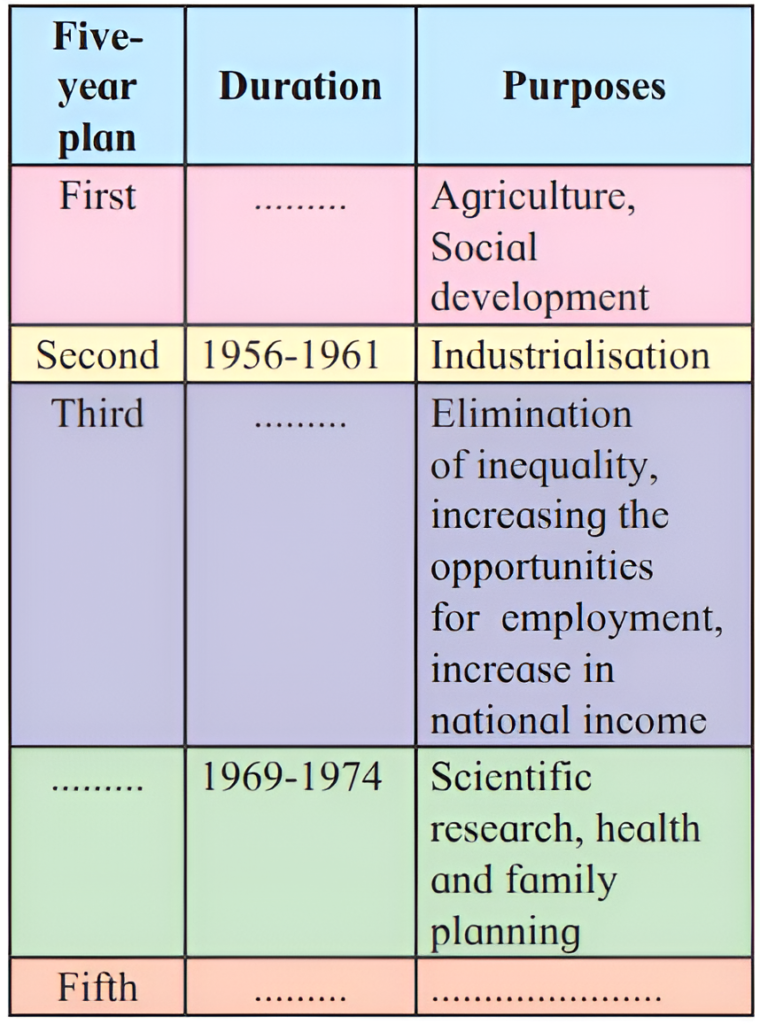
(A) Complete the following chart.
Answer.
| Five Year Plan | Duration | Purposes |
| First | 1951 -1956 | Agriculture and Social Development |
| Second | 1956 -1961 | Industrialisation |
| Third | 1961 -1966 | Elimination of inequality, increasing opportunities for employment, increase in national income. |
| Fourth | 1969 -1974 | Scientific research, health and family planning. |
| Fifth | 1974 -1979 | Making India economically self-sufficient by alleviating poverty. |
(B) Write short notes on-
(1) Mixed Economy
Answer.
(i) In a capitalist system, the means of production are privately owned. In a socialist economy, the means of production are owned by the State in the name of the society.
(ii) A mixed economy works both in the private and the public sector.
(iii) In order to achieve economic development of modem India, we gave preference to a model of ‘mixed economy’. We can see three parts in this kind of economy:
(a) Public Sector: The industries in this sector are completely under the control and management of the government. For example, production of defence equipment.
(b) Private Sector: The industries in this sector are owned by private industrialists. Of course, the government supervises and controls them too. For example, consumer goods.
(c) Joint Sector: In this sector, some industries are owned by private industrialists, while some are run under government management.
(iv) For mixed economy to run smoothly there is a need for co-ordination between the private sector and the public sector.
(v) This system aims at maximisation of production and popular participation on a large scale.
(vi) An effort has been made in this system to bring together the good aspects of both the capitalist and the socialist systems.
(vii) A mixed economy cannot ignore the profit motive, entrepreneurship, discipline, time bound planning, etc.
(2) 20-point Programme
Answer.
20-Point Programme: Prime Minister Indira Gandhi announced the 20-Point Programme on 1st July 1975 and resolved to make efforts towards rapidly becoming a developed nation. The main provisions of the 20 point programme are as follows:
- Land ceiling for cities and agricultural land, equal division of wealth, minimum wages for workers, increase in water conservation schemes.
- Workers’ participation in industry, national training scheme, freeing bonded labour.
- Prevention of tax evasion, economic crimes and smuggling.
- Regulation of prices of basic necessities, improvement in the public distribution system.
- Improvement in the textile industry by developing handloom sector, waiving loans for weaker sections, housing, communication facilities, making educational equipment available to schools.
3. (A) Explain the following statements with reasons.
(1) Independent India opted for mixed economy.
Answer.
(i) Our Prime Minister Pandit Nehru adopted the middle path rather than taking recourse to any extremes. Some countries had adopted Capitalism, while some had adopted Socialism. Each type of economy had its own advantages.
(ii) In a capitalist system, the means of production are privately owned. In a socialist economy, the means of production are owned by the State in the name of the society.
(iii) A mixed economy works both in the private and the public sector. In order to achieve economic development of modem India, we gave preference to a model of ‘mixed economy’.
(2) Banks were nationalised in 1969.
Answer.
(i) During the tenure of Prime Ministers Pandit Nehru and Lai Bahadur Shastri, banking was a monopoly of the private sector.
(ii) These banks represented different industrial groups. The Directors of these banks were working towards developing industrial sector and increasing its profit.
(iii) In order to stop this, the government nationalised the ‘Imperial Bank’ in 1955 and it got converted into State Bank of India.
(iv) This Bank opened several branches all over the country in a short while and played a major role in development.
(v) India had adopted a mixed economy after independence. Nationalisation of banks was essential to cover the deficits if they occurred while implementing different schemes.
(vi) Also the profit of these banks would come into the government treasury once they were nationalised. Prime Minister Indira Gandhi nationalised 14 banks on 19th July, 1969.
(3) Mill workers went on strike.
Answer.
(i) During the Diwali of 1981, the workers expected to get a bonus of 20%.
(ii) The Rashtriya Mill Mazdoor Sangh, which was negotiating with the employers, agreed upon 8 to 17% bonus without taking the workers into confidence.
(iii) The cut in the bonus proved to be the cause of unrest. Some workers went to Dr. Datta Samant.
(iv) They asked him to accept their leadership. Workers of 65 mills came together and Dr. Datta Samant led the strike. On 18th January 1982, two and a half lakh workers went on strike.
(B) Answer the following questions in detail.
(1) Which programmes were started in the 8th five-year plan?
Answer.
Following programmes were started in the Eighth Five Year Plan:
- Pradhanmantri Rozgar Yojana
- Mahila Samriddhi Yojana
- Rashtriya Samajik, Arthik Sahayya Yojana
- Midday Meal Scheme
- Indira Mahila Scheme
- Ganga Kalyan Scheme
(2) Which projects were started in the 2nd five-year plan ?
Answer.
(i) Iron and steel industries at Durgapur, Bhilai and Rourkela; Chemical fertilisers plant at Sindri; rail engine factory at Chittaranjan; factory of railway bogies at Perambur, Ship building factory at Vishakhapattanam and other heavy industries were set up in the Public Sector.
(ii) Huge dams like Bhakra-Nangal, Damodar, etc. were built to make water available for agriculture.