Endogenetic Movements Class 9 Geography Chapter 2 Questions And Answers Maharashtra Board
25 March 2026 EasyLearning
1. Tick in front of the correct option ✓
(a) On which of the following are slow movements in the earth’s interior dependent? Landforms [ ]
Velocity [ ]
Direction [ ]
Answer.
Velocity
(b) When waves divert from each other, what do they create? Compression [ ]
Tension [ ]
Mountain [ ]
Answer.
Tension
(c) For the formation of a rift valley, which of the following processes should occur in the earth’s crust?
Compression [ ]
Tension [ ]
Weathering [ ]
Answer.
Tension
(d) Which of these is a fold mountain?
The Satpudas [ ]
The Himalayas [ ]
The Western Ghats [ ]
Answer.
The Himalayas
(e) The formation of extensive plateaus is a result of which type of movements ?
Mountain-building [ ]
Continent-building [ ]
Horizonta [ ]
Answer.
Continent-building

2. Give geographical reasons.
(a) Buildings collapsed at the foothills of the Himalayas because of an earthquake. Before collapsing they were moving forward and backward.
Answer.
- Earthquakes release energy waves from the earth’s interior, causing the ground to shake.
- The chapter says primary (P) waves move buildings forward and backward, weakening them.
- At the Himalayas’ foothills, this shaking was strong, so buildings collapsed due to the force.
(b) There is a difference in the formation of the Meghalaya Plateau and the Deccan Plateau.
Answer.
- The Meghalaya plateau is formed due to slow movements (orogenic movements) whereas the Deccan Plateau is formed due to sudden movements (fissure volcano).
- During the formation of the Meghalaya plateau, a part of the Earth’s crust in between two parallel faults was lifted forming a plateau whereas, the Deccan plateau was formed due to molten material coming out with the eruption spreading on both sides of the fissure.
- Thus, there is a difference in the formation of the Meghalaya plateau and the Deccan plateau.
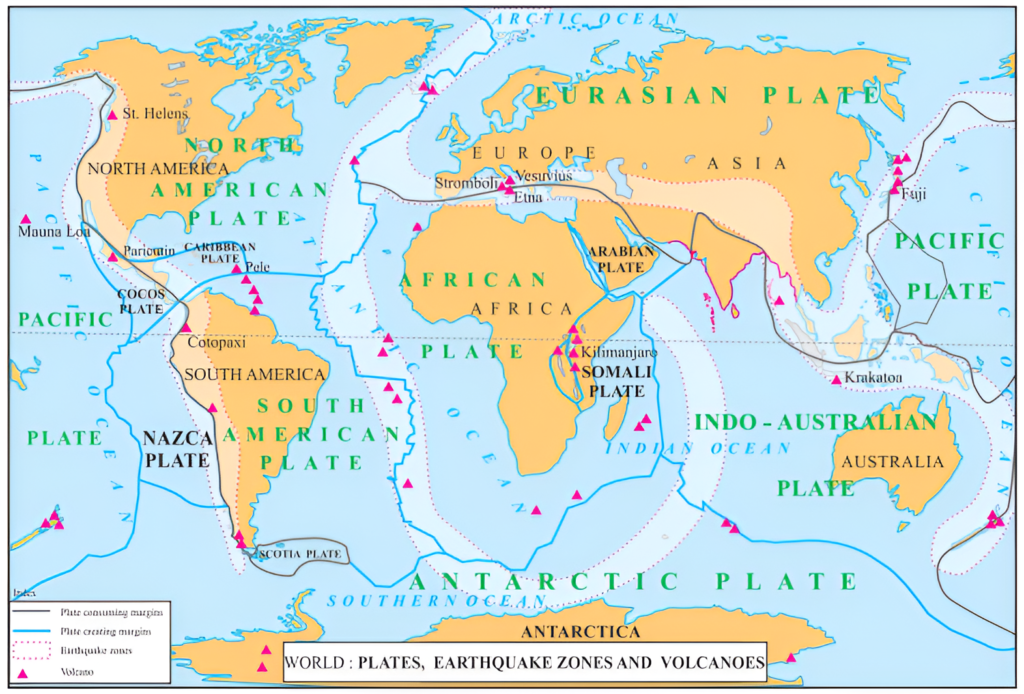
(c) Most of the volcanoes are found on the plate boundaries.
Answer.
- The plate boundaries are directly related to the areas of volcanoes.
- Most of the volcanoes are located on the plate boundaries.
- The part of the plate boundary which slides under the crust, results in the loss of material. Such boundaries are called plate consuming boundaries.
- In areas where new material (magma) is coming up onto the Earth’s crust, they are called plate creating boundaries.
- Both the processes result in earthquakes and volcanoes. Thus, most of the volcanoes are formed in the plate boundaries.
(d) The Barren Island is becoming conical in shape.
Answer.
- Barren island which was considered a dormant volcano has become active since February 2017.
- Mainly dust, smoke and mud are coming out of this eruption along with some lava.
- During eruption, the lava is spread around the mouth of this vent, when it comes out.
- As a result, a cone-shaped mountain starts forming.
(e) Volcanic eruptions can cause earthquakes.
Answer.
- Generally, the movements in the Earth’s interior occur in the upper layer of the mantle
- Tremendous energy is released by radioactive materials present here.
- This leads to a sudden movement in form of volcanic eruptions where hot solid, liquid and gaseous materials are forcefully thrown out from the mantle of the Earth, onto the surface of the Earth.
- This causes a lot of instability within the crust of the Earth which would also lead to the release of pressure in the form of seismic waves or tremors causing earthquakes.
3. Identify and name the internal movement.
(a) Tsunamis are generated in coastal areas.
Answer.
- Sudden movement
- This is an earthquake because the chapter says tsunamis happen when ocean earthquakes displace water.
(b) The Himalayas are an example of fold mountains.
- Slow movement
- This is mountain-building (orogenic) movement because the chapter says folds form from pressure over time.
(c) Molten magma is thrown out of the earth’s mantle.
- Sudden movement
- This is a volcanic eruption because the chapter describes it as magma coming out suddenly.
(d) Rift valley is formed because of faulting.
- Slow movement
- This is mountain-building movement because the chapter links faulting to tension forming rift valleys.
4. Arrange the following statements in chronological order in which an earthquake occurs.
(a) The earth’s surface vibrates
(b) The plates suddenly move.
(c) Due to the movements in the mantle, compression goes on increasing.
(d) Along the weak points ( faultlines) rocks break apart.
(e) Stored energy is released in the form of seismic waves.
Answer.
- (c) Due to the movements in the mantle, compression goes on increasing
- (b) The plates suddenly move
- (d) Along the weak points (fault lines) rocks break apart
- (e) Stored energy is released in the form of seismic waves
- (a) The earth’s surface vibrates
5. Distinguish between –
(a) Block Mountain and Fold Mountain
Answer.
| Block Mountain | Fold Mountain |
| (i) When a part of the earth’s crust between two parallel faults is lifted a block mountain is formed. | (i) Because of the energy waves and pressure working towards each other, the layers of the soft rocks form folds leading to the formation of fold mountains. |
| (ii) Block mountains are formed due to tension. | (ii) Fold mountains are formed due to compression. |
| (iii) e.g. The Black forest mountains of Europe and the Meghalaya Plateau of India. | (iii) e.g. The Himalayas, the Aravalis, the Rockies, the Andes, the Alps |
(b) Primary and Secondary Seismic Waves
Answer.
| Primary Seismic Waves | Secondary Seismic waves |
| (i) Primary waves are the first one to reach the surface of the earth after the energy is emitted in the Earth’s interior. | (i) The waves which reach the Earth’s surface after the primary waves are called secondary waves. |
| (ii) Primary waves can travel through solid, liquid and gaseous medium. | (ii) Secondary waves can travel only through only solid medium. |
| (iii) While travelling through liquid medium, primary waves change their direction. | (iii) Secondary waves get absorbed as they enter the liquid medium. |
| (iv) The waves move to and fro in the direction of energy transfer. | (iv) These waves move up and down in the direction of energy transfer. |
(c) Earthquakes and volcanoes
Answer.
| Earthquakes | Volcanoes |
| (i) Earthquake is the movement of the Earth’s crust. | A volcano is an opening in the Earth’s crust from which hot solid, liquid and gaseous materials are thrown out from the mantle of. |
| (ii) Nothing is ejected out during an earthquake. | During a volcanic eruption, ash, water vapor, various types of poisonous and inflammable gases, hot molten magma etc. is ejected from the earth’s interior. |
6. Answer in brief
(a) Give reasons why an earthquake occurs.
Answer.
- When the movements occur in the interior of the Earth, tremendous tension is created in the Earth’s crust.
- When the tension goes beyond limits, the energy is released in the form of waves.
- This results in the trembling of the earth’s surface, i.e. an earthquake occurs.
Following are the reasons for the occurrence of an earthquake:
- Moving of the plates
- Colliding of the plates
- Plates sliding one below the other
- Forming of fractures in rock layers, due to tension in the interior of the Earth.
- Occurring of volcanic eruption
(b) Which type of movements have led to the formation of the major fold mountains in the world?
Answer.
- Fold mountains are formed due to mountain-building (erogenic) movements.
- Energy is transferred from the interior of the Earth. Because of these energy waves and pressure working towards each other and in horizontal direction, the layers of the soft rocks form folds.
- If the pressure is very high, large scale folds are formed and their complexity increases.
- As a result, the surface of the Earth gets uplifted and fold mountains are formed.
- The Himalayas, the Aravalis, the Rockies, the Andes, the Alps are the major fold mountains of the world.
(c) How is the magnitude of the earthquake related to the collapse of houses?
Answer.
- Through a seismogram, a graph showing movement of seismic waves (seismograph) can be generated.
- After studying this graph, the magnitude of the earthquake is known.
- The magnitude of the earthquake is measured with the help of a richter scale.
- It is because of the primary waves that the buildings on the Earth’s surface move back and forth.
- The buildings on the Earth’s surface move up and down because of the secondary waves. These are more destructive than the T’ waves leading to collapse of buildings.
(d) What are the effects of earthquakes on the earth’s surface and human life?
Answer.
Following are the effects of earthquakes:
- Cracks/fractures develop on the ground.
- These causes landslides which leads to sliding of rocks.
- Sometimes the groundwater changes its course. For example, wells may get water, or may dry up.
- Some areas get uplifted while some may subside.
- Tsunamis are generated in oceans These waves can cause great loss of life and property in the coastal areas.
- In snow-covered areas, avalanches may occur.
- Buildings collapse and loss of life and property occurs.
- Transportation routes get disrupted.
- The communication system collapses.
(e) Explain the types of seismic waves.
Answer.
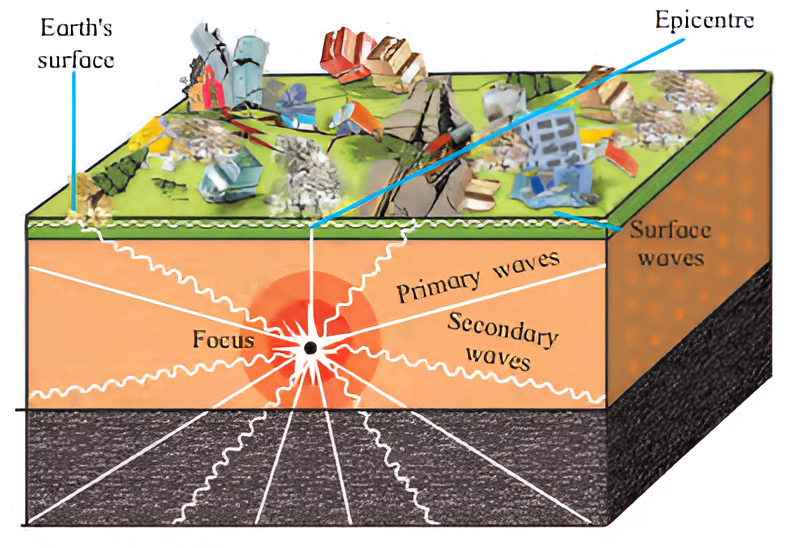
When the intension is released at the focus, the released energy travels in all directions. This energy comes towards the Earth’s surface in the form of waves. The seismic waves can be divided into primary, secondary and surface waves.
(i) Primary or ‘P’ waves:
- These waves are first to reach the surface of the Earth, after the energy is emitted in the Earth’s interior. They travel at a very fast speed from the focus of the earthquake in radial direction.
- The waves moves to and fro, therefore these waves are called forward-backward waves.
- These waves can travel through all the three states – liquid, solid and gaseous.
- While travelling through liquid medium, their direction gets changed. It is because of the primary waves that the buildings on the Earth’s surface move back and forth.
(ii) Secondary or ‘S’ waves :
- The waves which reach the Earth’s surface after I the primary waves are called secondary waves. :
- These waves also scatter in all directions from the focus of the earthquake.
- Their velocity is less than ’P’ waves.
- The particles lying in the way of these waves j move up and down in the direction of energy transfer.
- These waves can travel only through the solid medium and they get absorbed as they enter the liquid medium.
- The buildings on the Earth’s surface move up and down because of these waves. These are more destructive than ‘P waves.
(iii) Surface or ‘L’ waves :
- These waves are generated after the main ’P’ and ‘S’ waves reach the epicenter.
- They travel in the direction of the circumference of the Earth, along the crust and are highly destructive.
(f) Explain the types of volcanoes on the basis of periodicity of eruption with examples.
Answer.
According to the periodicity of the volcanic eruptions, three types of volcanoes can be identified.
(i) Active Volcanoes –
- If the volcanic eruptions are regular even in the present times, then such volcanoes are called active volcanoes.
- E.g., Mt Fujiyama in Japan and Mt. Stromboli in the Mediterranean Sea.
(ii) Dormant Volcanoes –
- When a volcano has not erupted since long, but may become active suddenly is called a dormant volcano.
- E.g., Mt. Vesuvius in Italy, Mt. Katmai in Alaska and Barren Island, India.
(iii) Extinct volcanoes –
- Those volcanoes which have not erupted in the past since long and are not likely to erupt in the future are called extinct volcanoes.
- E.g., Mr. Kilimanjaro in Tanzania.
7. Show the epicentre, focus and the primary, secondary and surface waves of an earthquake with the help of a neat labelled diagram.
Answer.
8. Show the following on a given outline map of the world.
(a) Mt. Kilimanjaro
(b) Mid-Atlantic Earthquake zone
(c) Mt. Fuji
(d) Krakatoa
(e) Mt. Vesuvius
Answer.