India and other Countries Class 9 Political Science Chapter 5 Questions And Answers Maharashtra Board
24 March 2026 EasyLearning
1. Choose the correct option from the given options and complete the statements.
(1) The country that has a free international border with India –
(a) Pakistan (b) Bangladesh
(c) Nepal (d) Myanmar
Answer.
(c) Nepal
(2) The countries that have tensed relations with India –
(a) Pakistan and China.
(b) Nepal and Bhutan
(c) Myanmar and Maldives
(d) Afghanistan and America.
Answer.
(a) Pakistan and China.
(3) Factors that have an influence on the relations between India and Pakistan –
(a) Difference in the world view of both the countries.
(b) Kashmir issue
(c) Nuclear Rivalry
(d) All of the above
Answer.
(d) All of the above

2. State whether the following statements are true or false. Give reasons for your answer.
(1) India has an important position among the South Asian countries.
Answer.
True.
- India’s position in Asia is geographically and politically important.
- Afghanistan, Pakistan, Sri Lanka, Bangladesh, Myanmar, Nepal, Bhutan, China and Maldives are India’s neighbours.
- The values of equality and mutual respect have a great importance in India’s foreign policy. India has established relations with neighbouring countries on the basis of these values.
- India is the biggest country in the Indian subcontinent. Similarly, India is economically and technologically more advanced. It is thus natural that India has a great influence among the South Asian countries.
(2) Sino-Indian relations are friendly.
Answer.
False.
- The conflict between India and China is connected to two issues : (a) Border issue and (b) The status of Tibet.
- The border dispute between India and China is related to the Aksai Chin area and the Macmahon line.
- China claims that the area, South of Aksai Chin and Macmahon line (Arunachal Pradesh) is Chinese Territory. China is not willing to agree that Macmahon Line is an international border.
- India made several efforts to sort this border dispute by means of dialogue, but it has not met with much success. In 1962, China Attacked India.
- When China was stepping up its military control in Tibet, Dalai Lama took asylum in India. This issue has been responsible for the conflict between the two countries.
(3) India sent a peacekeeping force to help the Sri Lankan government.
Answer.
True.
- India has friendly relations with the southern neighbour Sri Lanka.
- Political instability in Sri Lanka after 1985 was a result of the differences between the Tamil and the Sri Lankan Government. At that time,
India had sent a peace keeping force to help the Sri Lankan government. - Friendly relations with Sri Lanka are important from the point of view of security in the Indian Ocean.
3. Complete the following chart.
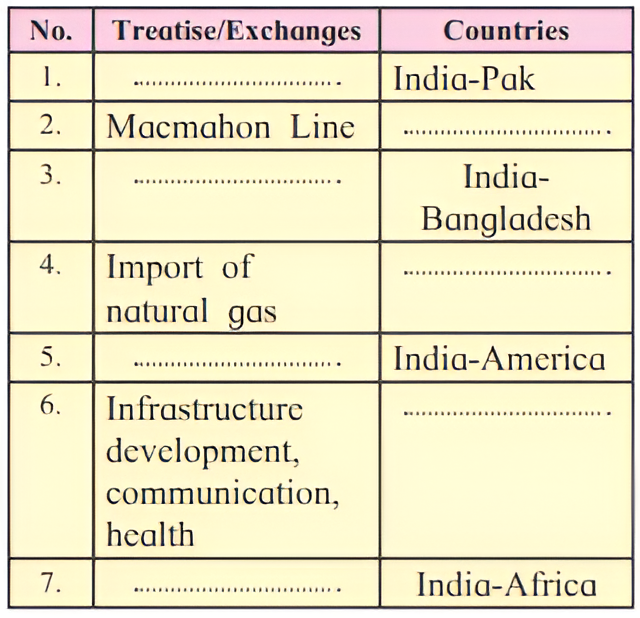
Answer.
| Treaties/Exchanges | Countries |
| Shimla Agreement, Tashkent Agreement | India and Pakistan |
| Macmahon Line | India and China |
| Treaties about sharing river waters and borders | India and Bangladesh |
| Import of natural gas | Myanmar |
| Civil Nuclear Agreement | India and Africa |
4. Explain the following concepts.
(1) Shimla Agreement
Answer.
(i) India tried to solve Indo-Pak conflict bi-laterally. The Shimla Agreement of 1972 was based on these principles.
(ii) Pakistan considers Kashmir as the biggest hurdle in establishing relations with India.
(iii) The first Indo-Pak war took place in 1965, over Kashmir. The Tashkent Agreement was signed in 1966, but nothing much came out of it.
(iv) Even though the 1971 war was about the creation of Bangladesh, it also had the dimension of the Kashmir problem to it.
(v) The Shimla Agreement in 1972 provided a new format to the interaction between India and Pakistan.
(2) Indo-Nepalese friendship treaty
Answer.
(i) The foundation of friendship between India and Nepal was laid with Indo-Nepalese Friendship Treaty in 1950.
(ii) According to this treaty, Nepalese citizens can not only enter India, but they are also permitted to take up government jobs and carry on trade in India.
(iii) The year 1990 marked the beginning of Nepal’s transition to democracy.
(iv) Nepal is dependent upon India for economic progress, basic facilities, food related needs, trade and energy needs.
(v) India sent a lot of help to Nepal at the time of the 2015 earthquake.
(3) Macmahon Line
Answer.
(i) The conflict between India and China is connected to two issues :
- Border issue
- The status of Tibet
(ii) The border dispute between India and China is related to Aksai Chin area and the Macmahon line.
(iii) China claims that the area South of Aksai Chin and Macmahon line (Arunachal Pradesh) is Chinese Territory.
(iv) China is not willing to agree that Macmahon Line is an international border.
(v) India made several efforts to sort this border dispute by means of dialogue, but it has not met with much success.
(vi) In 1962, China attacked India.
(4) Indo-Afghanistan Relations
Answer.
(i) There is a lot of political instability in Afghanistan.
(ii) The dominance of the terrorist organisation, Taliban is responsible for this.
(iii) India has extended help to bring peace, security and stability, curb violence and establish a democratic government.
(iv) Similarly, India is also helping Afghanistan in re-establishing communication facilities that have got destroyed due to war, build roads, cooperate in the fields of science and technology, build schools, health facilities and irrigation projects.
5. Answer in brief.
(1) Explain the background of cooperative relations between India and America.
Answer.
India and America are two powerful nations who have democratic political systems. Right from the beginning, America was India’s most important trading partner.
(i) Many Indians have gone to America for education or work. Due to the presence of these non-resident Indians, the cultural, social and economic relations between America and India have been increasing.
(ii) After the end of Cold War, the military relations between India and America have increased on a large scale.
(iii) After India accepted free market economy, the speed of economic progress slowly increased. It resulted in further strengthening the trade relations between India and America.
(iv) When India conducted nuclear tests in 1998, there was tension in the relations between the two countries.
(v) Many rounds of discussions took place after that to improve the relations. Through these rounds of talks, America came to believe that India will use its nuclear weapons with responsibility. This completely transformed the Indo-American relations.
(vi) The Civil Nuclear Agreement signed in 2005 that was approved by the U.S. Congress in 2008 was an important landmark in Indo-American relations.
(2) Give some information about the efforts taken by India for the establishment of democracy in neighbouring countries with examples.
Answer.
India upheld sovereignty and democratic values in Nepal, Afghanistan, Sri Lanka and Pakistan.
(i) Nepal was a Hindu Kingdom which adopted democratic government in 2006. India backed up its decision of adopting popular rule by helping Nepal with constitutional guidelines.
(ii) India also extended friendly relations to Ashraf Ghani through SAARC and other international platforms after the collapse of Taliban there.
(iii) India sent a peacekeeping force to Sri Lanka to bring about a cease fire between Sinhalese and Tamils and enforce peace and democracy.
(iv) The regime of Pervez Musharraf had adopted aggressive foreign policies and oppressed public opinion in Pakistan which led to violence and chaos. India had also criticised military rule in Pakistan.
(3) What is the role of South Asian Association for Regional Cooperation ?
Answer.
SAARC is a regional organisation established by the South Asian countries in 1985.
(i) The aim of this organisation is to encourage economic co-operation between South Asian nations and thereby achieve the development of the South Asian region.
(ii) The organisation of SAARC is a platform for South Asian countries to come together and discuss common questions and interests.
(iii) Some common interests of South Asian countries are alleviation of poverty, development of agriculture and technological revolution.
(iv) Some treaties were signed on the SAARC platform to make it easy for South Asian countries to trade with each other.
(v) As a part of this, it has been decided that South Asia should be made into a free trade area. For an equitable development of South Asian nations, a treaty about forming South Asian Free Trade Area was signed and South Asian University was established.