India : Events after 1960 Class 9 History And Political Science Chapter 2 Questions And Answers Maharashtra Board
18 March 2026 EasyLearning
1. (A) Choose the correct option from the given options and complete the statements.
(1) The Prime Minister of India who took an initiative in resolving the question of the Tamil minority in Sri Lanka was ………… .
(a) Rajiv Gandhi
(b) Indira Gandhi
(c) H. D. Devegowda
(d) P. V. Narasimha Rao
Answer.
(a) Rajiv Gandhi.
(2) ………. is the father of the Green Revolution in India.
(a) D. R. Verghese Kurien
(b) Homi Bhabha
(c) M. S. Swaminathan
(d) Dr Norman Borlaug.
Answer.
(c) M. S. Swaminathan

(B) Identify and write the wrong pair.
(1) Indira Gandhi – National Emergency
(2) Rajiv Gandhi – Development in science and technology
(3) P. V. Narasimha Rao – Economic improvements
(4) Chandrashekhar – Mandal Commission.
Answer.
(4) Chandrashekhar – Mandal Commission (It was actually implemented during Vishwanath Pratap Singh’s tenure).
2. Complete the activity as per given instruction.
(A) Based on the information in the chapter, prepare a chronological chart of Prime Ministers and their tenure.
Answer.
- Jawaharlal Nehru (1947-1964)
- Lal Bahadur Shastri (1964-1966)
- Indira Gandhi (1966-1977, 1980-1984)
- Morarji Desai (1977-1979)
- Charan Singh (1979-1980)
- Rajiv Gandhi (1984-1989)
- Vishwanath Pratap Singh (1989-1990)
- Chandra Shekhar (1990-1991)
- P. V. Narasimha Rao (1991-1996)
- Atal Bihari Vajpayee (1996, 1998-2004)
- H. D. Deve Gowda (1996-1997)
- Inder Kumar Gujral (1997-1998)
(B) Write short notes on-
(1) Globalisation
Answer.
(1) The formation of a single market by all the countries in the world is known as ‘globalisation’. That is, building a ‘global economy’.
(2) This facilitated free flow of goods, services, technology and labour across the world. Economic reforms were introduced. Restrictions on trade were removed.
(3) There were financial investment in trade and business which led to its expansion. There was increase in employment opportunities.
(4) Globalisation brought about changes in finance, politics, science and technology, social and cultural sphere.
(2) White Revolution
Answer.
(1) The objective of Indian economy after independence was to modernise economy and achieve economic self-sufficiency. Many scientists and industrialists contributed for the same.
(2) Dr. Verghese Kurien was appointed as Chairman of Dairy Development Board, at Anand in Khed district of Gujarat.
(3) The experiment in co-operative dairy movement was led by Dr. Verghese Kurien.
(4) It led to increase in milk production in India. This is called ‘White Revolution’.
3. Give reasons.
(1) The Morarji Desai government lasted for short while.
Answer.
(1) Many opposition parties came together and formed Janata Party in 1977 against the backdrop of emergency.
(2) Janata Party defeated Congress and came to power in 1977.
(3) Shri Morarji Desai became the Prime Minister in 1977.
(4) However, due to the internal differences among the constituent parties of the Janata Party, the government of Shri Morarji Desai could not last long.
(2) The army had to be sent into the Golden Temple in Amritsar.
Answer.
(1) During the decade of 1980s, the separatist Sikhs in Punjab demanded an independent state of Khalistan.
(2) The movement of Khalistan became violent and destructive.
(3) Pakistan had lent support to this movement.
(4) So, to evict the terrorists who had allegedly taken shelter in the Golden Temple in Amritsar, the Government of India sent the army.
(3) The National Planning Commission was set up in India.
Answer.
(1) After independence, India wanted to achieve economic development and eliminate poverty by means of industrialisation.
(2) India wanted to modernise economy, achieve economic self-sufficiency and establish social justice through planning.
(3) India wanted to acquire modernity and self reliance by establishing industries.
(4) Five-year plans needed coordination. Therefore, the (National) Planning Commission was established in 1950.
4. Answer the following questions in detail.
(1) How was 1991 a year of important changes in the history of the world and of India ?
Answer.
Many important events took place in India and world in 1991 :
(1) With the end of cold war in 1991, the Soviet Russia disintegrated into several countries.
(2) The Narasimha Rao government started economic reforms called as economic liberalisation.
(3) The Indian economy flourished as a result of the implementation of this policy.
(2) What are the characteristics of the Indian economy?
Answer.
[Wrongly given as the ‘characteristics’ in the textbook]
The objectives of Indian economy are as follows :
(1) India wanted to acquire modernity and self reliance by establishing industries.
(2) India wanted to establish an economy based on social justice through planning.
(3) For this, the National Planning Commission was established that would coordinate development through the policy of Five-Year Plans.
(4) In this manner modernisation of economy, economic self-sufficiency and social justice have been the objectives of the Indian economy.
5. With the help of the information in the chapter, complete the list of the challenges before India and the strengths of India.
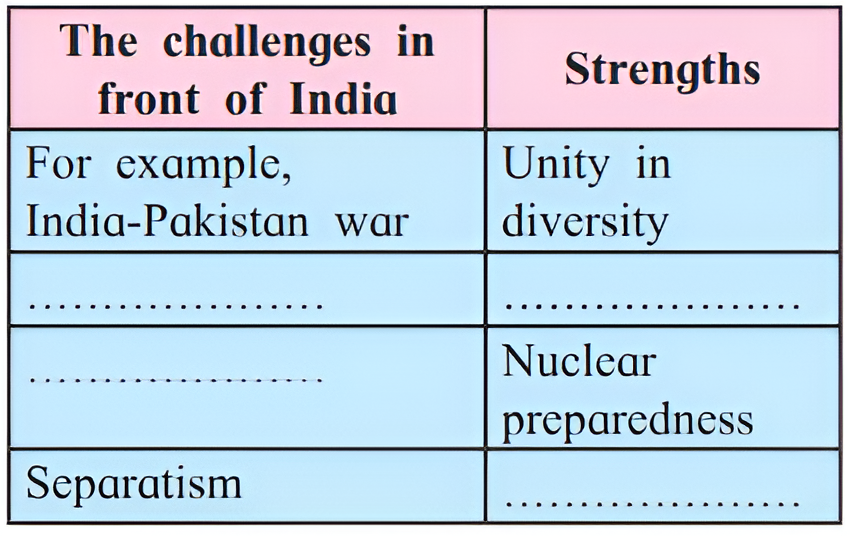
Answer.
| The Challenges In Front of India | Strengths |
| India-Pakistan war | Unity in diversity |
| Cross – Border Terrorism | Membership in G20 and BRICS |
| Corruption | Nuclear preparedness |
| Separatism | Establishment of National Planning Commission |