Laws of Motion Class 9 Science Chapter 1 Questions And Answers Maharashtra Board
10 February 2026 EasyLearning
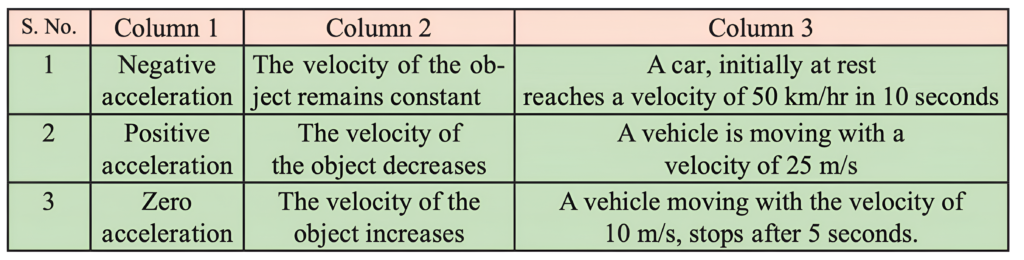
1. Match the first column with appropriate entries in the second and third columns and remake the table.
Answer.
| Column 1 (Type) | Column 2 (Description) | Column 3 (Example Scenario) |
|---|---|---|
| Negative acceleration | The velocity of the object decreases | A vehicle moving with the velocity of 10 m/s, stops after 5 seconds. |
| Positive acceleration | The velocity of the object increases | A car, initially at rest reaches a velocity of 50 km/hr in 10 seconds. |
| Zero acceleration | The velocity of the object remains constant | A vehicle is moving with a velocity of 25 m/s |

2. Clarify the differences
A. Distance and displacement
B. Uniform and non-uniform motion.
Answer.
A. Distance and Displacement
| Distance | Displacement |
|---|---|
| (i) Distance is the length of the actual path travelled by an object. (ii) It is a scalar quantity. (iii) It is either equal to or greater than displacement. (iv) Distance travelled is always positive. | (i) Displacement is the minimum distance between the starting and finishing points. (ii) It is a vector quantity. (iii) It is either equal to or less than distance. (iv) Displacement may be positive or negative or zero. |
B. Uniform and Non-Uniform motion
| Uniform motion | Non-uniform motion |
|---|---|
| (i) If an object covers equal distances in equal intervals of time it is said to be in uniform motion. (ii) Distance – time graph for uniform motion is a straight line. (iii) In uniform motion, acceleration is zero. | (i) If an object moves unequal distances in equal intervals of time, its motion is said to be nonuniform. (ii) Distance – time graph for non-uniform motion is not a straight line. (iii) In non-uniform motion acceleration is non-zero. |
3. Complete the following table.

Answer. (i) 14 (ii) 10

Answer. (i) 69 (ii) 8

Answer. (i) 8 ( for v = 8 m/s ) (ii) 4 ( for v = 10 m/s )
4. Complete the sentences and explain them.
a. The minimum distance between the start and finish points of the motion of an object is called the …………. of the object.
b. Deceleration is ………….. acceleration
c. When an object is in uniform circular motion, its ………… changes at every point.
d. During collision …………. remains constant.
e. The working of a rocket depends on Newton’s ……….…. law of motion.
Answer.
a. Displacement
The minimum distance between the start and finish points of the motion of an object is called the displacement of the object.
- Explanation: While “distance” refers to the total path length traveled, displacement is a vector quantity that represents the straight-line shortcut between the initial and final positions. If you run in a complete circle and end where you started, your distance is the circumference, but your displacement is zero.
b. Negative Deceleration is Negative acceleration.
• Explanation: Acceleration refers to any change in velocity. When an object slows down, its final velocity is less than its initial velocity (v < u). When calculated using a = v – u/t , the result is a negative value, which we commonly call deceleration or retardation.
c. Velocity
When an object is in uniform circular motion, its velocity changes at every point.
- Explanation: Even if the speed (magnitude) remains constant, the direction of motion is constantly changing as the object moves along the curve. Because velocity is a vector quantity (speed + direction), a change in direction means the velocity is technically changing at every moment.
d. Total Momentum
During collision, total momentum remains constant.
- Explanation: According to the Law of Conservation of Momentum, if no external unbalanced force acts on two colliding bodies, the total momentum before the collision is equal to the total momentum after the collision. The momentum is simply transferred between the objects.
e. Third
The working of a rocket depends on Newton’s third law of motion.
- Explanation: Newton’s third law states that for every action, there is an equal and opposite reaction. A rocket pushes exhaust gases downward at high velocity (Action); in response, the gases push the rocket upward with an equal force (Reaction).
5. Give scientific reasons.
a. When an object falls freely to the ground, its acceleration is uniform.
Answer.
- When the body falls freely to the ground, there are equal changes in velocity of the body in equal intervals of time.
- Thus the acceleration of the body is constant, and it possesses uniform acceleration.
b. Even though the magnitudes of action force and reaction force are equal and their directions are opposite, their effects do not get cancelled.
Answer.
- Action and reaction forces act on different bodies.
- They don’t act on the same body, hence they cannot cancel each other’s effect.
- Hence, even though the magnitudes of action force and reaction force are equal, they do not cancel each other.
c. It is easier to stop a tennis ball as compared to a cricket ball, when both are travelling with the same velocity.
Answer.
- Momentum of an object depends on its mass as well as its velocity.
- Cricket ball is heavier than a tennis ball. Although they are thrown with the same velocity, cricket ball has more momentum than a tennis ball.
- The force required to stop a cricket ball is more than a tennis ball.
- Hence it is easier to stop a tennis ball than a cricket ball moving with same velocity.
d. The velocity of an object at rest is considered to be uniform.
Answer.
- When a body is at rest there is no change in velocity.
- A body with constant velocity is said to be in uniform motion.
- Hence, the state of rest is an example of uniform motion.
6. Take 5 examples from your surroundings and give explanation based on Newtons laws of motion.
Answer.
Five examples from everyday surroundings:
- A Book Resting on a Table (First Law – Inertia): According to Newton’s First Law, an object at rest stays at rest unless acted upon by an external force. The book remains stationary because the downward force of gravity is balanced by the upward force (normal force) of the table.
- Kicking a Soccer Ball (Second Law F = ma : Newton’s Second Law states that acceleration depends on force and mass. A harder kick (higher force) on a soccer ball (mass) results in greater acceleration, making the ball fly faster and further.
- Walking on the Ground (Third Law – Action/Reaction): Newton’s Third Law states for every action, there is an equal and opposite reaction. As you walk, your feet push the ground backward (action), and the ground pushes your feet forward with equal force (reaction).
- Stopping a Car Suddenly (First Law – Inertia): When a car stops suddenly, passengers jolt forward. The body wants to continue in its state of motion (inertia) even though the car has stopped due to the brakes.
- Releasing an Inflated Balloon (Third Law – Action/Reaction): When air rushes out of a balloon (action), the balloon moves in the opposite direction (reaction), demonstrating that the force of the air causes an equal and opposite force on the balloon.
7. Solve the following examples.
a) An object moves 18 m in the first 3 s, 22 m in the next 3 s and 14 m in the last 3 s. What is its average speed? (Ans: 6 m/s)
Answer.
Given,
Total distance (d) = 18 + 22 + 14 = 54 m
Total time taken (t) = 3 + 3 + 3 = 9 sec
To find:
Average speed = ?
Formula:
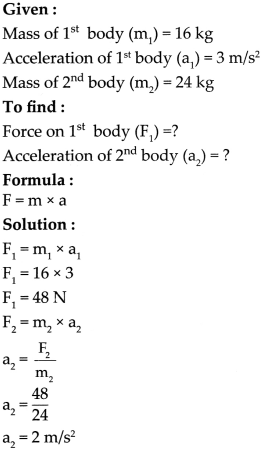
b) An object of mass 16 kg is moving with an acceleration of 3 m/s2 . Calculate the applied force. If the same force is applied on an object of mass 24 kg, how much will be the acceleration? (Ans: 48 N, 2 m/s2 )
Answer.
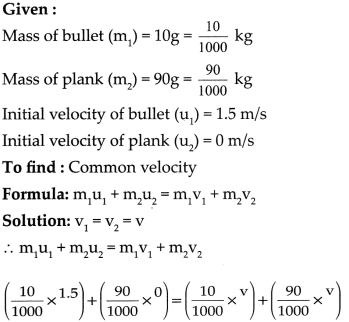
c) A bullet having a mass of 10 g and moving with a speed of 1.5 m/s, penetrates a thick wooden plank of mass 900 g. The plank was initially at rest. The bullet gets embedded in the plank and both move together. Determine their velocity. (Ans: 0.15 m/s)
Answer.
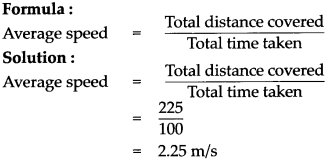
d) A person swims 100 m in the first 40 s, 80 m in the next 40 s and 45 m in the last 20 s. What is the average speed? (Ans: 2.25 m/s2 )
Answer.
Given:
Total distance (d) = 100 + 80 + 45 = 225 m
Total time taken (t) = 40 + 40 + 20 = 100 sec
To find:
Average speed =?