Life Processes in Living Organisms Class 9 Science Chapter 15 Questions And Answers Maharashtra Board
25 February 2026 EasyLearning
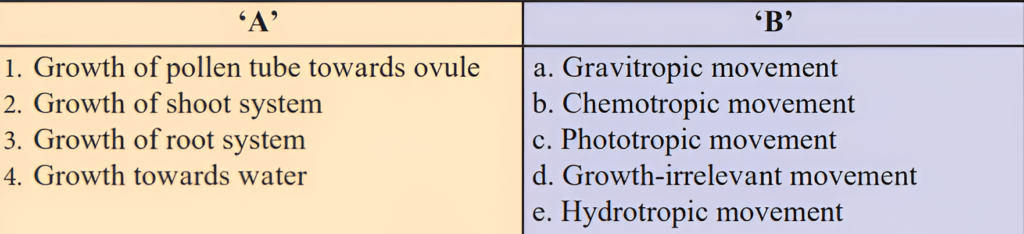
1. Match the pairs and explain.
Answer.
(1 – b),
(2 – c),
(3 – a),
(4 – e)

2. Complete the paragraph.
The milk was on the stove. Rasika was engrossed watching television. She smelled something burning. She ran towards the kitchen. The milk was boiling over. She held the vessel with her bare hands but, screaming, she let it go at once. This activity was controlled by ……………….. cells. Special ends of ……………….. in these cells collected the information, from where it was transferred to the ……………….. and then towards the terminal end of the ……………….. The chemicals produced at the terminal end passed through the minute space i.e. ………………. . In this way, ……………….. were conducted in the body and the process of ……………….. was completed by conducting the impulses from ……………….. to ……………… (Nerve, muscle cell, impulse, dendrite, synapse, axon, reflex action, cell body)
Answer.
Nerve, dendrite, cell body, axon, synapse, impulses, reflex action, nerve, muscle cell.
3. Write notes on
Root pressure, Transpiration, Nerve cell, Human brain, Reflex action
Answer.
1. Root pressure
(1) The pressure created in the root cells is called a root pressure. Root cells are in contact with water and minerals in the soil. But the concentration inside the cells and the concentration in the surrounding soil is different from each other and thus there is concentration gradient created.
(2) Due to concentration gradient, the water and minerals from the surrounding areas enter in the root cells.
(3) Due to this, the root cells become turgid and exert pressure on the adjacent cells.
(4) Due to root pressure, the water and minerals enter the xylem present in the roots. To reduce this difference in concentration they are continuously pushed forward. This continuous movement creates a water column that is continuously pushed ahead.
(5) The pressure exerted by the root cells thus is sufficient to lift the water up in small shrubs and small trees.
2. Transpiration
(1) There are stomata on the leaves of the plants. Through these opening the excess of water is thrown out in the form of water vapours. This process is called transpiration.
(2) There are two guard cells around the opening of stomata. They have an external membrane. They control the opening and closing of the stomata.
(3) Also some amount of water is lost due to evaporation from the leaves.
(4) As a result, water level in the epidermal layer of the leaf decreases.
(5) To compensate this loss, more water is brought to the leaves through the xylem.
(6) Transpiration thus helps in absorption of water and minerals and their distribution to all parts of the plant.
(7) Root pressure pushes the water up during the night time.
3. Nerve cell
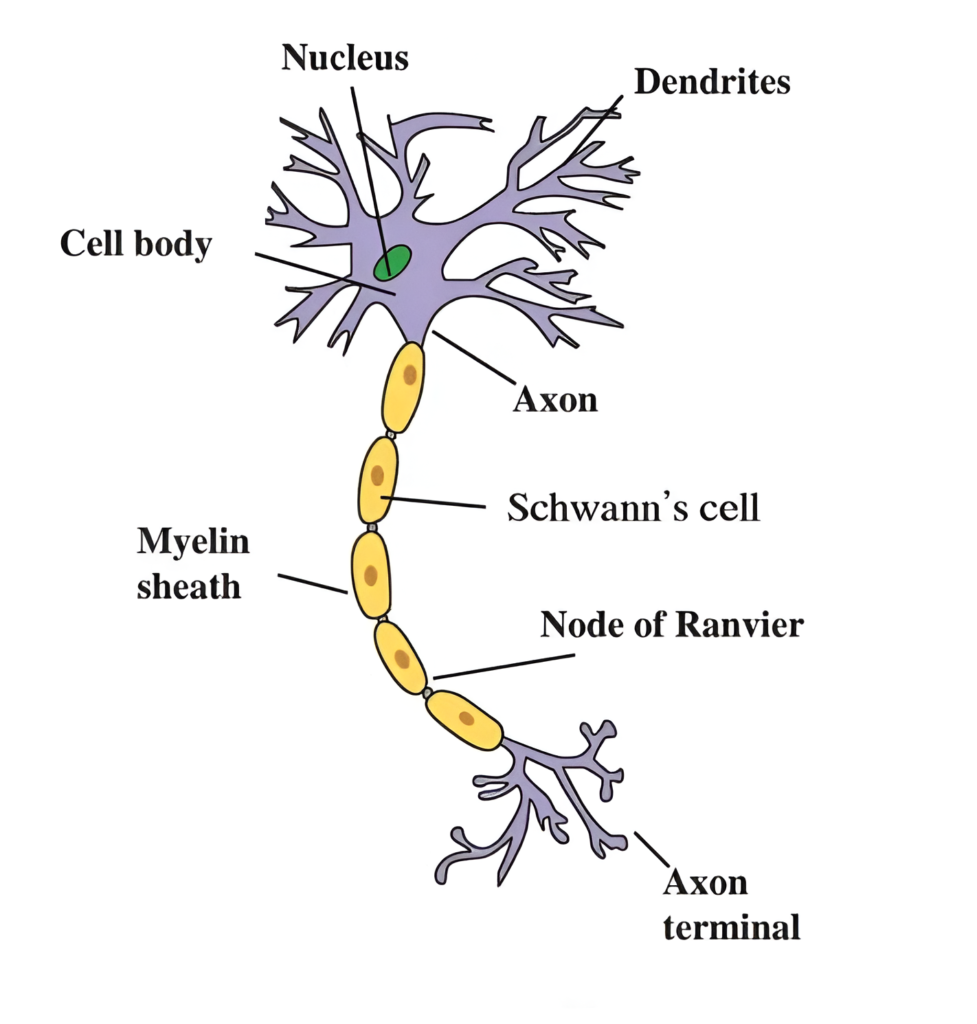
(1) Neurons or nerve cells are structural and functional units of the nervous system that carry impulses from one place to other.
(2) Neuron has the ability to generate and conduct electrochemical impulses.
(3) Every neuron has three main parts, viz. cyton or cell body, axon and dendrites. Dendrites pick up the electrochemical signals produced.
(4) These signals are transferred to cyton and from cyton they are sent to axons. From axon of one neuron, the impulse is then given to dendrites of next neuron.
4. Human brain
(1) Human brain is highly evolved organ. It is the main controlling centre of nervous system. It is the part of the central nervous system. It is very well protected inside the cranium or cranial cavity.
(2) The brain is enclosed by meninges which are protective coverings. There are hollow ventricles inside the brain which are filled up with cerebrospinal fluid. This fluid is protective and nourishing in function. The average weight of adult human brain is about 1300 – 1400 grams and there are approximately 100 billion neurons in the brain.
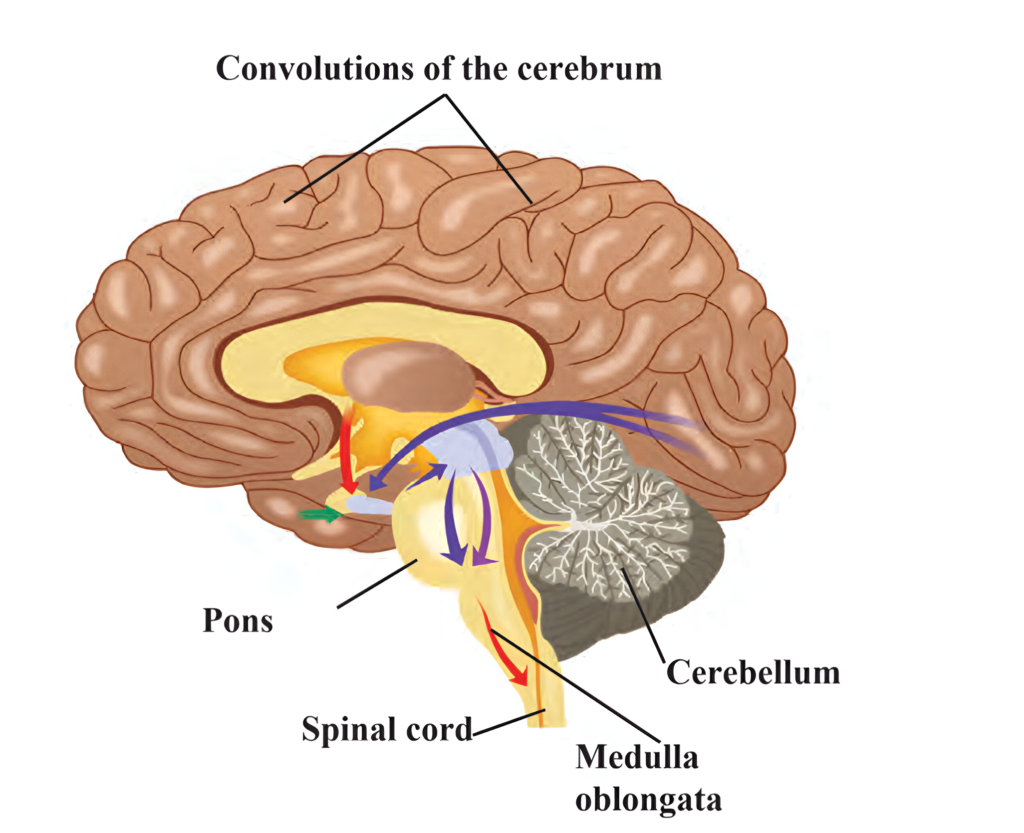
(3) There are three main parts of the brain, viz. Cerebrum, cerebellum and medulla oblongata.
5. Reflex action
(1) Reflex action is an immediate and involuntary response given to a stimulus from the environment.
(2) The reflex action is so spontaneous that it does not require thinking or control by our brain.
(3) Reflex actions are not controlled by brain. But the control and coordination is maintained by the reflex actions by which the load on the brain is
reduced. They are of survival value as a person is saved from a dangerous situations due to reflex actions.
(4) The path of reflex action is as follows : This is also known as reflex arc. Sense organs Sensory neurons -> Towards the spinal cord -> Coordination neuron -> Motor neuron-> Muscle or gland.
4. Name the hormones of the following endocrine glands and the function of each.
Pituitary, Thyroid, Adrenal, Thymus, Testis, Ovary.
Answer.
- Pituitary
| Hormone | Function |
| (i) Growth hormone | Stimulates growth of bones. |
| (ii) Adrenocorticotropic hormone | Stimulates adrenal gland. |
| (iii) Thyroid-stimulating hormone | Stimulates thyroid gland. |
| (iv) Prolactin | Stimulates milk production. |
| (v) Follicle-stimulating hormone | Controls growth of gonads. |
| (vi) Luteinizing hormone | Controls menstrual cycle and ovulation. |
| (vii) Oxytocin | Contracts uterus during parturition. |
| (viii) Antidiuretic hormone | Regulates water-level in the body. |
2. Thyroid
| Hormone | Function | |
| (i) Thyroxine | Controls growth of body and metabolic activities. | |
| (ii) Calcitonin | Controls calcium metabolism and calcium level in blood. | |
3. Adrenal
| Hormone | Function |
| (i) Adrenalin and nor-adrenalin | Controls behaviour during crisis and emotional situation. |
| (ii) Corticosteroid | Maintains balance of Na+ and K+ and stimulates metabolism. |
4. Thymus
| Hormone | Function |
| Thymosin | Control the cells which give rise to immunity. |
5. Testis
| Hormone | Function |
| Testosterone | Stimulates growth of secondary sexual characteristics like beard, mustache, hoarse voice etc. in men. |
6. Ovary
| Hormone | Function |
| (i) Oestrogen | Stimulates growth of the endometrium. Stimulates growth of secondary sexual characteristics in women. |
| (ii) Progesterone | Prepares the endometrium for conception and maintains pregnancy. |
5. Draw and label the diagrams.
Human endocrine glands, Human brain, Nephron, Nerve cell, Human excretory system.
Answer.
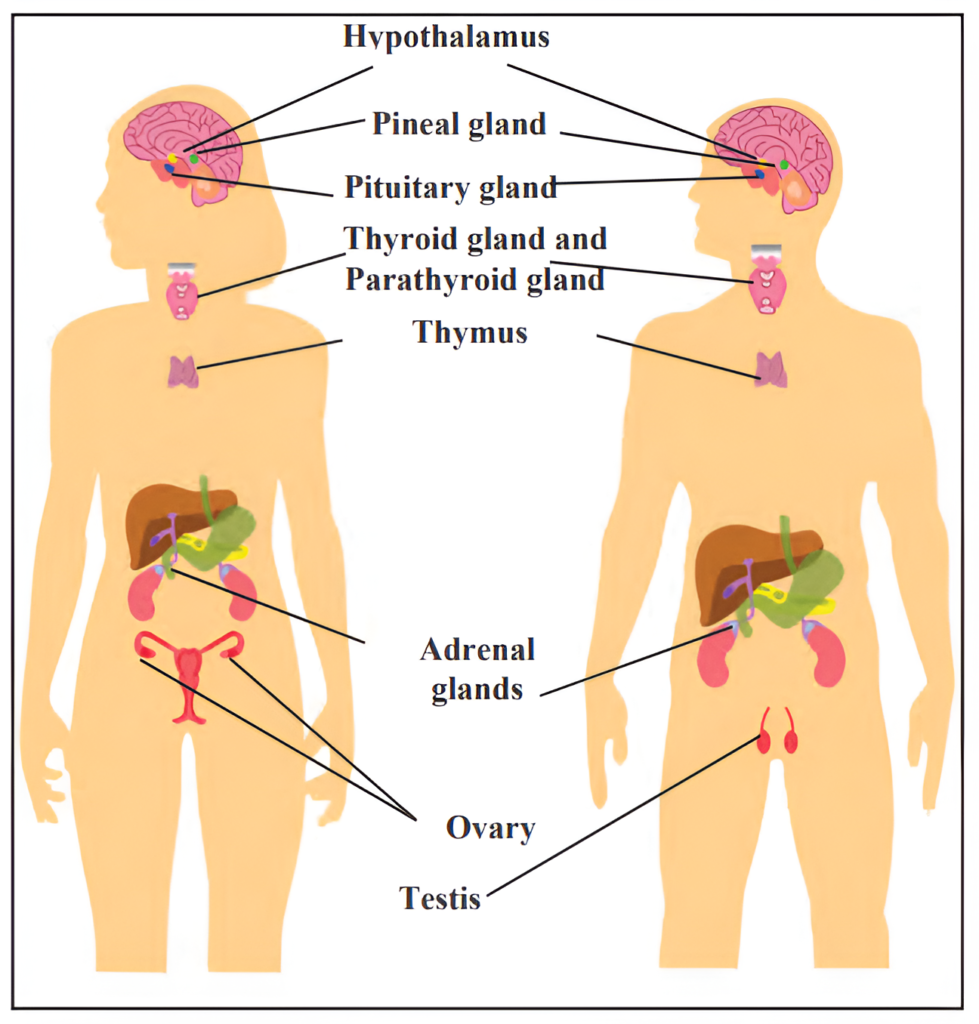
1. Human endocrine glands
2. Human brain
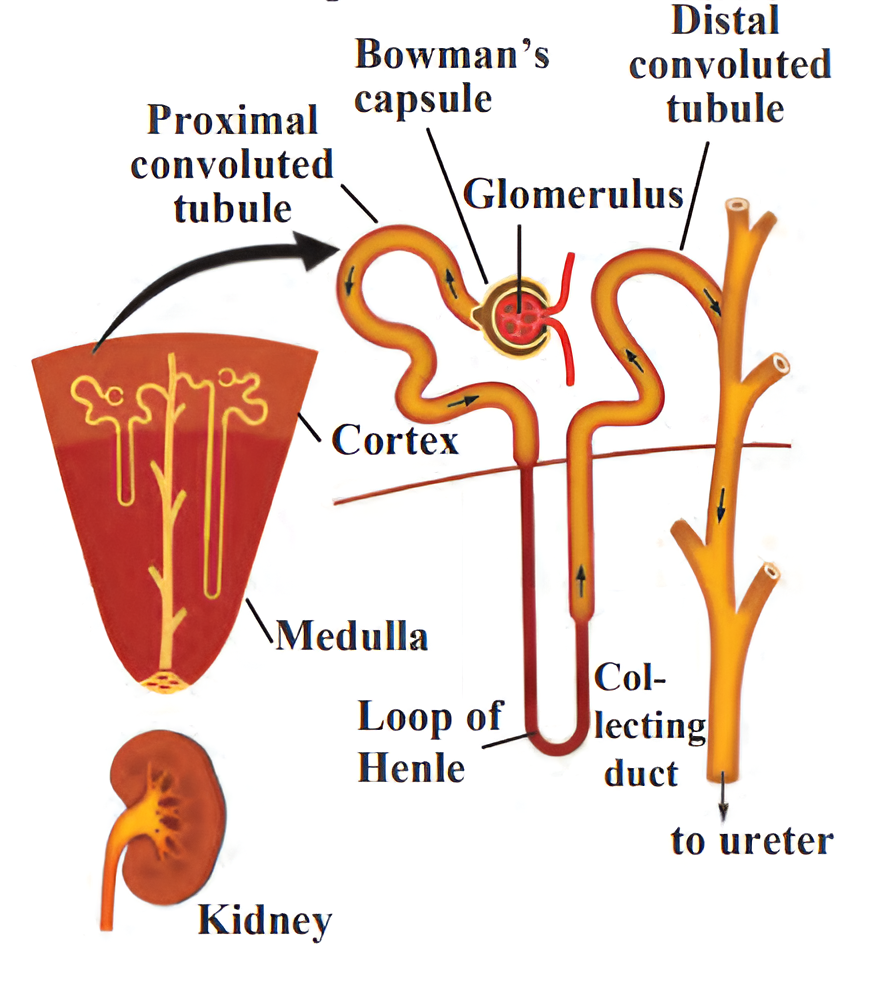
3. Nephron
4. Nerve cell
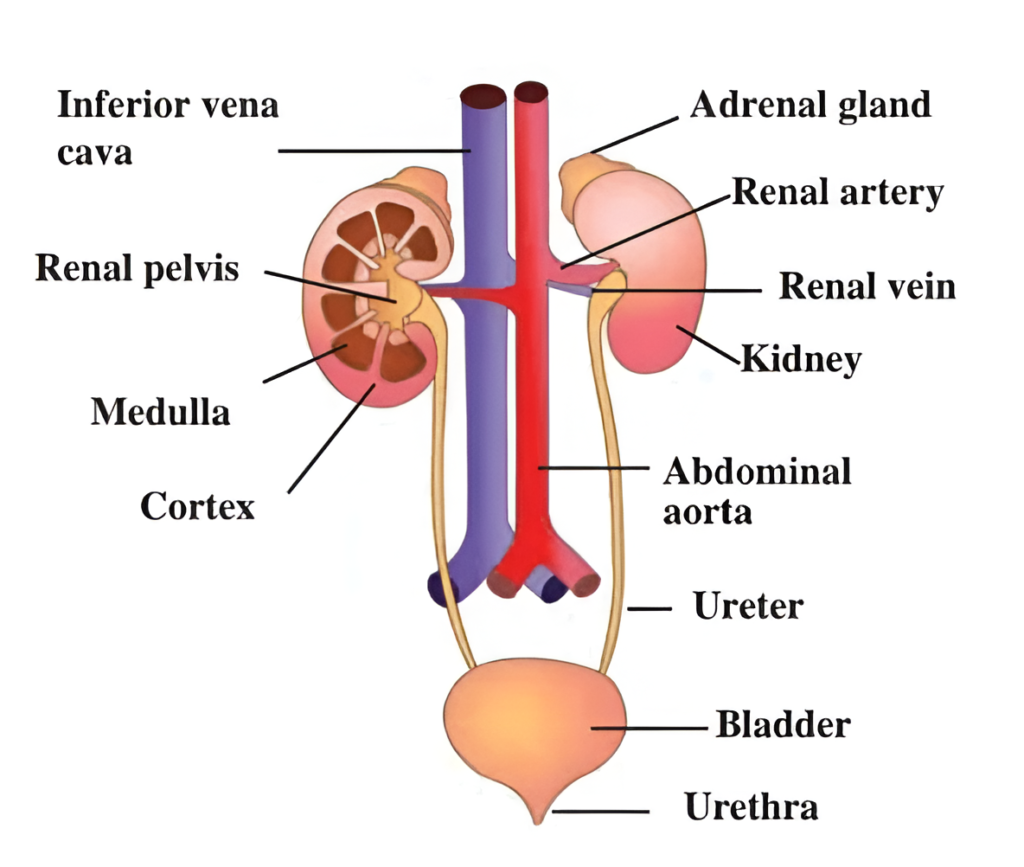
5. Human excretory system
6. Answer the following.
a. Explain chemical co-ordination in humans and give the names and functions of some hormones.
Answer.
Chemical co-ordination in humans :
- In humans chemical co-ordination is brought about with the help of certain chemical substances called hormones.
- Hormones are secreted by endocrine glands. These glands are also called ductless glands.
- These glands do not have any arrangement of their own to either store or carry their secretions. So, the hormones are directly released into the blood circulation.
- Though the endocrine glands are present at specific locations in our body, their secretions reach all parts of the body via the blood.
- Endocrine glands along with the nervous systems are responsible for control and co-ordination in our body.
These two systems help each other to control and integrate the various activities of the body. - A marked difference between these two systems is that nerve impulses are fast but short-lived whereas the actions of hormones are very slow but long-lasting.
- It is very important that hormones are secreted only in the required quantity and there is a special mechanism which controls the quantity and timing of hormone secretion.
- For example, whenever there is an increase in blood glucose level, certain cells in the pancreas get stimulated and as a response, they release a greater quantity of insulin, thus bringing down the sugar level to normal.
| Hormone | Function |
| (1) Growth hormone | Stimulates growth of bones. |
| (2) Luteinizing hormone | Controls menstrual cycle and ovulation. |
| (3) Thyroxine | Controls growth of body and metabolic activities. |
| (4) Insulin | Stimulates liver to convert excess blood glucose to glycogen. |
| (5) Testosterone | Stimulates growth of secondary sexual characters like beard, mustache, hoarse voice, etc. in men. |
b. Explain the difference between the excretory system of humans and plants.
Answer.
| Excretory system of humans | Excretory system of plants |
| (i) In humans, the excretory system carries out the function of the removal of waste from the body. | (i) In plants, there is no special system or organ for excretion. |
| (ii) Waste substances are generally eliminated out of the body | (ii) Most of the waste substances are stored in the leaves, flowers, fruits and bark of the stem. |
| (iii) The excretory products are urea, uric acid, ammonia, etc. | (iii) The excretory products are gum, resin, latex of rubber, etc. |
c. Explain co-ordination in plants with the help of suitable examples.
Answer.
- Plants do not have systems like the nervous system or muscular system.
- In plants, movements are mainly in the form of responses given to the stimuli.
- Plants show two types of movements – growth relevant movements and growth irrelevant movements.
- Movement or growth of any part of the plant in response to an external stimulus is called tropism or tropic movement.
- Examples of growth-relevant movements are :
- The shoot system of any plant responds to the light stimulus i.e., it grows towards the source of light. This is called phototropic movement.
- The root system of plants responds to stimuli like gravitation and water. These responses are called gravitropic movement and hydrotropic movement respectively.
- Movement shown by plants in response to specific chemicals is called chemotropic movement.
- For example, the growth of the pollen tube towards the ovule.
- Some specific movements of the plants do not lead to the plant growth.
- Such movements are called growth-irrelevant movements.
- As a response to changes in the surroundings, plant hormones bring about various movements in plants.
- Examples of growth irrelevant movements are closing of leaflets of Touch-me-not (Mimosa) plant on touch.
- In the plant called Venus fly trap, when an insect visits the flower like trap, the trap closes up and the trapped insect is digested by the plant.
- The lotus flower opens during day-time while that of the tuberose opens at night.
- In plants like Touch-me-not (Mimosa), movement also occurs at places other than where it has been touched.
- Hence, we can infer that the information about the touch must have been released within the plant from one place to another.
- Plants use electrochemical impulses for transfer of information from one place to another.
- Plant cells change their shape by increasing or decreasing the water content and thereby, bring about the movements of plants.
7. Explain in your own words with suitable examples.
a. What is meant by co-ordination?
Answer.
- Several different organ systems function in multicellular organisms.
- Their life goes on smoothly if there is co-ordination between different organ systems or organs and the stimuli in the surrounding.
- Depending upon this, we can say that systematic regulation of different processes can be called control and bringing about the different processes in the proper sequence is called co-ordination.
- If any activity in the body is to be completed successfully, proper co-ordination between different systems, and organs participating at different steps of that activity is necessary.
- If due to lack of co-ordination, there is confusion at any step, the activity may not get completed. There should be no randomness at any step.
- There should be proper co-ordination between internal activities of the body resulting from various factors like body temperature, water- level, enzyme-level, etc. or stimuli arising in the surrounding environment.
- Proper co-ordination between various systems of an organism helps to maintain a state of equilibrium called homeostasis which is necessary for the optimal efficiency of the body.
b. How does excretion occur in human beings ?
Answer.
- Removal of wastes from the body is very important and it is the excretory system that carries out this function.
- The human excretory system consists of a pair of kidneys, a pair of ureters, the urinary bladder and the urethra. Urine is formed by the kidneys by separating the waste and unwanted excess substances from the blood.
- The functional unit of the kidney that performs the basic function of filtration is called a nephron. The urea produced in the liver comes into the blood.
- When the urea-containing blood comes into the glomerulus, it is filtered through capillaries and urea and other similar substances are separated from it.
- Water molecules and small molecules of some other substances can cross the semipermeable membrane of Bowman’s capsule.
- The solution accumulated in the cavity of Bowman’s capsule passes into the tubular part of the nephron. Here, molecules of water and some other useful substances are reabsorbed into the blood.
- Urine is formed from the remaining solution which is full of waste materials. The urine is carried by the ureters and stored in the urinary bladder. Afterwards, urine is given out through the urethra.
c. How is excretion in plants useful to human beings?
Answer.
- Plants give out oxygen during photosynthesis by diffusion which is useful to human beings for respiration.
- Some waste materials of plants for example, gum, resin, latex of rubber, etc. are useful to humans.
d. Describe the transportation system in plants.
Answer.
- Plants have two types of conducting tissues i.e., xylem which conducts water and phloem which conducts food.
- During transpiration, water is released into the atmosphere.
- As a result, water level is the epidermal layer of the leaf decreases.
- Water is brought up to the leaves through the xylem so as to compensate for the lost water.
- Transpiration helps in absorption of water and minerals and distribution to all parts of the plant whereas root pressure preforms the important role of pushing the water up at night time.
- The food produced by leaves is transported to each cell of the plant through phloem.
- When the food material like sucrose is transported towards a part of the plant through phloem, using ATP, the water concentration in that part decreases.
- As a result, water enters the cell by diffusion. The pressure on the cell wall increases due to increase in the cellular contents.
- Due to the increased pressure, food is pushed into the neighboring cells where the pressure is low.
- This process helps the phloem to transport the materials as per the need of the plant.