Science and Technology Class 9 History And Political Science Chapter 7 Questions And Answers Maharashtra Board
19 March 2026 EasyLearning
1. (A) Choose the correct option from the given options and complete the statements.
(1) _______ was named as the first Chairman of Atomic Energy Commission.
(a) Dr Homi Bhabha
(b) Dr Homi Sethna
(c) Dr A.P.J. Abdul Kalam
(d) Dr Raja Ramanna
Answer.
(a) Dr Homi Bhabha
(2) ________ was the first completely indigenous communication satellite made by ISRO.
(a) Aryabhatta
(b) Insat 1 B
(c) Rohini-75
(d) Apple
Answer.
(d) Apple
(B) Identify and write the wrong pair.
(1) Prithvi – surface to surface ballistic missile
(2) Agni – surface to underwater ballistic missile
(3) Akash – from surface to air attacking missile
(4) Nag – anti-tank missile
Answer.
Wrong Pair: Agni – Surface-to-Sea ballistic missile

2. (A) Complete the activity as per the given instruction.
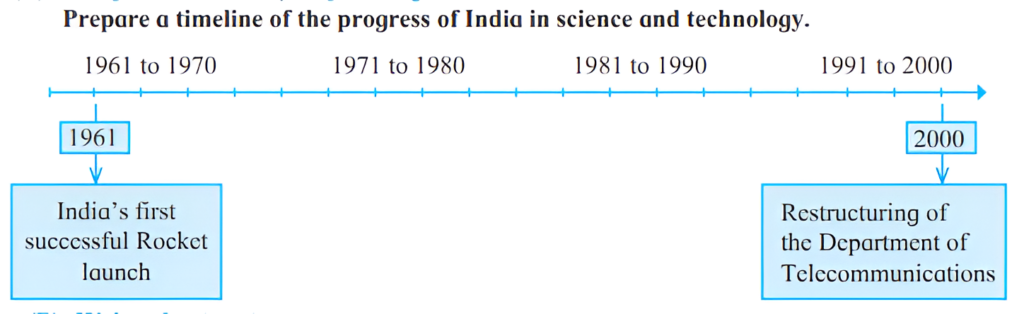
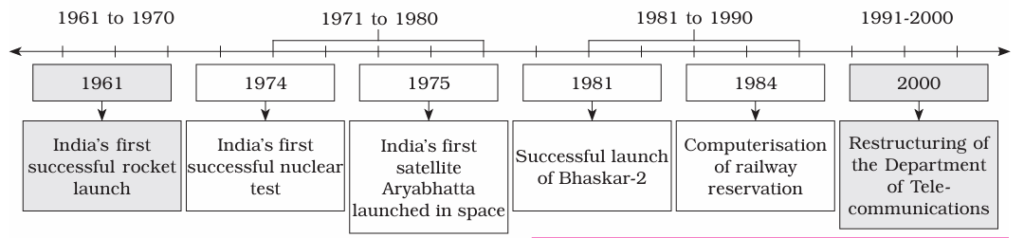
Answer.
The progress of India in Science and Technology.
(B) Write short notes on-
(1) Space research
Answer.
(1) Space research is to explore space and to study the earth with space technology.
(2) The space technology includes the development of the rockets and the satellites, launched from the earth station.
(3) The Indian Space Research Organisation (ISRO) was established to work in the field of space research in India.
(4) Various satellites were launched in space by India.
(2) Telex service
Answer.
(1) Telex service implies transmission of the typed messages from one part of the country to another rapidly through telex machines.
(2) The Department of Telecommunications under the Ministry of Communication launched the telex service in India in 1963.
(3) The telex service in Devanagari script was started in 1969.
(4) However, with the emergence of the internet service in 1990s, the significance of the telex service has declined.
(3) Pokhran nuclear test
Answer.
(1) It was necessary for India to develop nuclear weapons due to China’s nuclear capability and Pakistan’s desperate efforts to acquire nuclear weapons with China’s help.
(2) India’s policy was to use nuclear energy for peaceful purposes and self-sufficiency.
(3) Accordingly, India successfully performed her first nuclear test at Pokharan in Rajasthan on 18th May, 1974.
(4) Pokharan was chosen as the location for conducting the nuclear test on the basis of the criteria of being far away from human settlements and having no groundwater reserves.
(4) Bhaskar – 1 satellite
Answer.
(1) Bhaskar-1, a remote sensing experimental satellite developed by ISRO was launched by India from Soviet Russia in 1979. This satellite is useful in the following fields :
(2) To observe things on the surface of the earth by remote sensing technology.
(3) For weather forecasting.
(4) For clicking photographs of the bowels of the earth, environment and forests.
(5) Useful for oceanography.
3. Explain the following statements with reasons.
(1) Pandit Nehru established the Atomic Energy Commission.
Answer.
(1) India’s first Prime Minister Pandit Jawaharlal Nehru wanted to nurture a scientific temper.
(2) He wanted to bring about economic development of the nation by making use of science and technology, produce electricity by atomic energy, develop nanotechnology and increase the yield of foodgrains.
(3) Therefore, Pandit Nehru established the Atomic Energy Commission on 10th August, 1948.
(2) India decided to conduct nuclear tests.
Answer.
(1) India’s neighbouring country, China, had acquired nuclear capability.
(2) Pakistan was making desperate efforts to acquire nuclear weapons with the help of China.
(3) To use nuclear energy for peaceful purpose and aquire self-sufficiency was its objective.
(4) To defend the country against the hostile neighbours, India decided to conduct nuclear tests.
(3) USA imposed economic sanctions on India.
Answer.
(1) On 11th May, 1998 India carried out its second nuclear test to prove its nuclear preparedness.
(2) One of the three tests conducted was of the Hydrogen Bomb.
(3) India joined the ranks of the nuclear powers.
(4) Prime Minister Atal Bihari Vajpayee assured that there would be no first use of nuclear weapons by India.
(5) However, to halt India’s nuclear programme, the USA imposed economic sanctions on India.
4. Answer the following questions in detail.
(1) Which of the everyday services are influenced by the satellite technology?
Answer.
The following services of the day-to-day use are influenced by satellite technology :
(1) Television : Doordarshan and the other private channels telecast their programmes with the help of the satellites.
(2) Mobile telephones operate with the help of satellites.
(3) Radio : 207 radio stations are connected by INSAT 1-B.
(4) Computer and Internet services are linked with the satellites.
(2) Why is Dr. A.P.J. Abdul Kalam called as the ‘Missile Man’?
Answer.
(1) After 1983, Dr. A.P.J. Abdul Kalam was the head of India’s Defence Research and Development Organisation (DRDO).
(2) Integrated Guided Missile Development Programme (IGMDP) was conceived by and was carried out under his leadership.
(3) The missiles Agni, Prithvi, Nag and Akash were developed under his guidance.
(4) Several missiles were developed due to his efforts.
(5) Owing to his contribution in the production of missiles, Dr. A.P.J. Abdul Kalam is called the ‘Missile Man’.
(3) How one can do computerised reservation for rail travel ?
Answer.
(i) There is a site called IRCTC for online railway bookings. On it’s site, sign up option is given through which Login Id and Password is created for IRCTC account. One must login with this ID and password for booking railway ticket. A captcha image needs to be filled to ensure the account is not being misused.
(ii) To the left of the page on the site, a column is given to enter the destination and boarding point, along with the date on which the journey is supposed to be made. After filling this, the list of trains along with their numbers, berth system, schedules is shown. The Quota, i.e. general, ladies, senior citizen needs to be filled here.
(iii) Here, if the ladies quota is selected, the berth is booked in the compartment reserved exclusively for ladies. If senior citizen quota is selected, exemption in travel fees is given.
(iv) After this, berth preferences i.e. sleeper, second seating is to be selected to book the tickets. Upon which, a new window opens for filling the details like name of the passenger, age, etc. A captcha image needs to be filled again to confirm booking.
(v) The gateway to online payment opens up which is done through Debit Card or Internet Banking, whichever is easier for the person booking it. A message of confirmation and email is received to the person booking it for his/her detail.
(4) Write the key features of Konkan Railway.
Answer.
Konkan railway which was started in 1998 has following features :
(1) It stretches over four states and covers over a distance of 760 km.
(2) There are over 92 tunnels on this route and the longest tunnel is 6.5 km at Karbude.
(3) There are 179 big and 1819 small bridges on this route. The biggest bridge is on the river Sharavati is at Honnawar. It is 2065.8 m long.
(4) The tallest bridge 64 m is built on river Panval near Ratnagiri.
(5) Sensors are fitted on railway engines to avoid accidents on track prone to landslides.