1. Choose the correct option from the given options and complete the statements.
(1) This was the main objective behind establishing the Indian Atomic Energy Commission –
(a) enhance military capacity
(b) conduct nuclear tests
(c) to stop the proliferation of nuclear weapons
(d) production of atomic energy
Answer.
(a) Enhance military capacity
(2) The following is now the objective of all the nations of the world –
(a) atomic development
(b) economic development
(c) nuclear test
(d) security system
Answer.
(b) economic development
(3) The ………. is an important aspect of India’s foreign policy –
(a) free economic policy
(b) interdependence
(c) non-alignment
(d) nuclear development
Answer.
(c) non-alignment
(4) India conducted nuclear tests in 1974 at –
(a) Shriharikota
(b) Thumba
(c) Pokharan
(d) Jaitapur
Answer.
(c) Pokharan

2. State whether the following statements are true or false. Give reasons for your answer.
(1) Pandit Nehru contributed towards improving Sino-Indian relations.
Answer.
True.
Self-opinion based
- Pandit Nehru formulated Panchsheel which was a treatise of the five principles of peaceful coexistence to govern relations between India and China. The first formal codification in the form of a treaty was an agreement between China and India in 1954.
- Mutual non-interference in internal affairs, mutual non-aggression, equality of mutual benefit, mutual respect, and peaceful co-existence were the principles for seeking peace with China.
- Nehru backed China’s permanent membership in the United Nations Security Council.
- Though Nehru had a policy of improving Sino- Indian relations, China attacked India in 1962.
(2) Atal Bihari Vajpayee took lead in improving relations with Pakistan.
Answer.
True.
Evaluative, self-opinion based
- In an effort to develop friendly relations, India and Pakistan have started a bus service called ‘Sada-e-Sarhad’ (Call of the border) between Delhi and Lahore when Atal Bihari Vajpayee was the Prime Minister. He also revived the train called Samjhauta Express (Friendship Express).
- Atal Bihari Vajpayee rendered help to the earthquake victims of Pakistan during the rule of Pervez Musharraf.
- In 1999, there was another war between India and Pakistan in the Kargil region over the Kashmir issue. India defeated Pakistan in this war as well.
- Atal Bihari Vajpayee tried to establish a dialogue with Pakistan but was not successful.
3. Explain the following concepts.
(1) India’s Foreign Policy
Answer.
(i) India got independence in 1947 and from then onwards India started shaping its Foreign Policy independently.
(ii) Article 51 among the Directive Principles of State Policy lay down the broad framework for Foreign Policy.
(iii) According to it, India should give priority to safeguard international peace and security, and resolve our international problems and disputes by peaceful means.
(iv) The objectives of our Foreign Policy should be to maintain friendly relations with other nations and respect international law.
(2) National Interest
Answer.
(i) National interest implies the means through which the independence and sovereignty of our country can be safeguarded.
(ii) National interest also includes efforts to achieve our economic development and to take steps towards increasing our national power.
(iii) When decisions are taken after giving careful thought to what is beneficial and good for our country, we say that we are nurturing our national interest.
(3) World Peace
Answer.
(i) World peace is an ideal state of freedom, peace, and happiness among and within all nations and people.
(ii) This idea of world non-violence provides a basis for peoples and nations to willingly co-operate.
(iii) Either voluntarily or by virtue of a system of governance, that prevents warfare.
(iv) India has been consistently supporting efforts for disarmament because it is India’s policy that there should be peace and security.
4. What is your opinion about the fact that world peace is threatened due to nuclear preparedness ?
Answer.
Nuclear preparedness leads to an Arm’s Race. It increases the possibilities of wars.
(i) If a nuclear bomb exploded in a major city, the blast center would be hotter than the surface of the sun.
(ii) Survivors would have no electricity, no transportation, no phones, and hospitals would be overwhelmed if they were still standing
(iii) India is now a country that has nuclear weapons. We have accepted the role of a responsible nuclear power. India has been consistently supporting efforts for disarmament because it is India’s position that there should be peace and security in the world.
5. Answer the following questions in brief.
(1) On what principles is India’s foreign policy based?
Answer.
(i) India got independence in 1947 and from then onwards we started shaping our foreign policy independently.
(ii) The Directive Principles of State Policy have laid down guidelines about how to shape Foreign Policy. Article 51 among the Directive Principles of State Policy lay down the broad framework for foreign policy.
(iii) According to it, India should give priority to safeguard international peace and security, and resolve our international problems and disputes by peaceful means.
(iv) The objectives of our foreign policy should be to maintain friendly relations with other nations and respect international law. India’s Foreign Policy till now has been developed in this framework.
(2) Who has contributed to improving Sino-Indian relations ?
Answer.
(i) Prime Minister Atal Bihari Vajpayee contributed a great deal to improving Sino-Indian relations.
(ii) The President, the Prime Minister, the Foreign Minister, the Defence Minister, the Finance Minister, and the Home Minister have a role in deciding foreign policy.
(iii) The persons holding these positions try to maintain the continuity in Foreign Policy and to improve upon it.
(3) Write the objectives of India’s foreign policy.
Answer.
Objectives of India’s Foreign Policy are as follows:
- While maintaining friendly relations with neighboring countries, ensure that the defense and security of India are not affected.
- Not to compromise about the geographical boundaries of the nation.
- Protect the unity and integrity of the country.
- Protect the interests of India’s citizens living in other countries. This responsibility is fulfilled by the Indian embassies there.
- To establish economic and commercial relations with other countries for achieving the economic development of India.
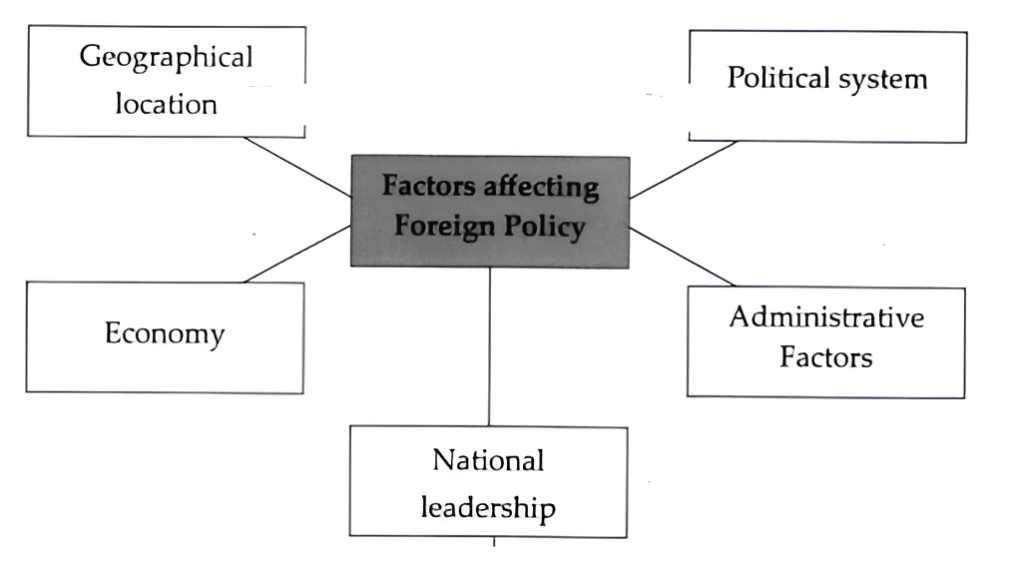
6. Prepare the following concept map.
Answer.