
1. Choose the correct option from the given options and complete the statements.
(1) The ………… of India is the Commander-in-Chief of all the Defence Forces.
(a) Prime Minister
(b) President
(c) Defence Minister
(d) Governor
Answer.
(b) President
(2) The …………….. has the responsibility of protecting the coastline.
(a) Army
(b) Coast Guard
(c) Border Security Force
(d) Rapid Action Force
Answer.
(b) Coast Guard
(3) The …………….. has been established with the purpose of instilling among students the love of discipline and military training.
(a) Border Securty Force (BSF)
(b) Central Reserve Police Force (CRPF)
(c) National Cadet Core (NCC)
(d) Rapid Action Force (RAF)
Answer.
(c) National Cadet Core (NCC)

2. State whether the following statements are true or false. Give reasons for your answer.
(1) It is necessary to end terrorism to ensure human security.
Answer.
True.
- The biggest challenge to human security is that of terrorism.
- Terrorism targets common, innocent people.
- It aims at creating terror or fear in their minds, so that they begin to feel insecure.
- Thus, in order to protect human security, it is necessary to put an end to terrorism.
(2) Every nation creates a strong security system for itself.
Answer.
True.
- National Security is closely connected with geography because national security is more likely to be endangered by nations who are geographically closer.
- A nation must assess the threat to its geographical boundaries and the source of that threat.
- In order to keep this threat at bay, the nation has to increase its military might.
- The nation has to use modem technology to predict the threat, to build weapon systems and modernize and update the defence forces.
(3) There are no issues of dispute between India and Pakistan.
Answer.
False.
- There are several disputes between India and Pakistan. For example, the Kashmir issue, disputes over river water sharing, the problem of infiltrations, dispute over the border, etc.
- India has continually tried to solve these issues through discussion and negotiations.
3. Explain the following concepts.
(1) The functions of the Rapid Action Force
Answer.
The Rapid Action Force performs the task of bringing people’s lives to normalcy by moving in quickly in incidents of the threat to National Security such as bomb blasts or riots.
(2) Human Security
Answer.
(i) In the Post – Cold War period, the concept of National Security changed and became broader. National Security is not just the security of the country but also of the people living in it, because security is ultimately for the people.
(ii) Hence; human security refers to human-centric thinking. In human security, it is expected that human beings should be protected from all sorts of dangers and they should be given the opportunities of education, health and development.
(iii) The concept of human security also includes the idea that a conducive environment should be created for everybody to live a respectable life by overcoming illiteracy, poverty, superstition, backwardness, etc. Human security necessitates the protection of the rights of minorities and weaker sections.
(3) Home Guard
Answer.
(i) This organisation was established in the pre-independence period. Citizens can join the Home Guards and assist in the defence of the country.
(ii) Any citizen, man or woman, between the age of 20 and 35 years can join the Home Guards.
(iii) This force has the following tasks: Maintain public security, supply of milk, water and other essential services during riots or strikes, to regulate traffic, to help people at the time of natural disasters like floods, earthquakes, etc.
4. Answer the following questions in brief.
(1) What are the threats to national security ?
Answer.
(i) India’s security is not only threatened by outside powers, but also from within. It is not just the difference between external security and internal security that is important anymore.
(ii) Religion, regionalism, several rebellious movements based on ideology, race-ethnicity and economic inequality are creating instability. For example, the Naxalite movement is a threat to India’s internal security.
(2) Write the functions of the Border Security Force.
Answer.
The Border Security Force performs tasks like:
- creating a sense of security in the minds of people living in areas near the border,
- preventing smuggling,
- patrolling the border, etc.
5. Complete the activity as per the given instructions.
(1) Complete the table about security forces.
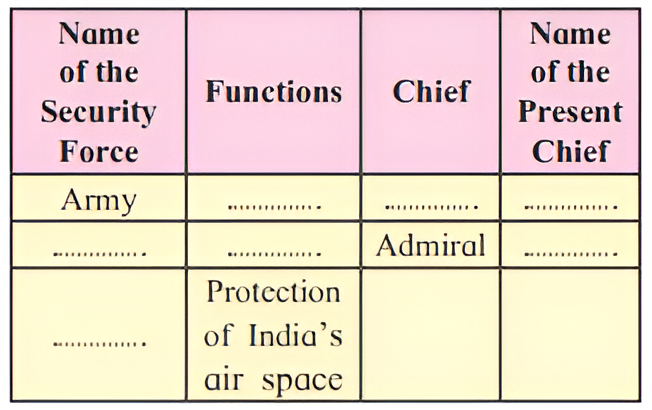
Answer.
| Name of the Security Forces | Functions | Chief | Name of the Present Chief |
| Army | Protection of geographical boundaries | General | Manoj Mukund Naravane |
| Navy | Protection of the coast line | Admiral | Karambir Singh |
| Air Force | Protection of India’s air space | Air Chief Marshall | Rakesh Kumar Sing Bhadavria |
(2)
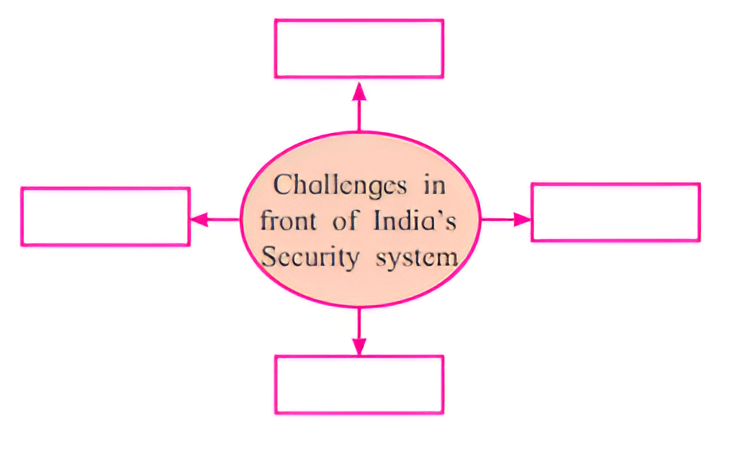
Answer.
Challenges in front of India’s Security System:
- Terrorism – Cross-border and internal terrorism pose a threat to national security.
- Border Disputes – Conflicts with neighboring countries like China and Pakistan create tensions.
- Cyber Threats – Online hacking, data theft, and cyber warfare can harm national security.
- Internal Insurgencies – Naxalism and separatist movements challenge internal stability.