
1. Answer in brief
(a) What is mechanical weathering ?
Answer.
- The disintegration of rocks without any change in their chemical composition is called mechanical weathering.
- The minerals in the rocks expand because of heat and contract when the temperature decreases. Due to such continuous contracting and expansion, tension develops in the rock particles.
- Each mineral reacts differently to the temperature; some minerals expand more, while others do not expand as much. Consequently, the tension formed in the rocks also increases and decreases. As a result, cracks develop in the rocks and they break.
- In areas where the temperatures drop below 0°C for quite some time, the water accumulated in the cracks and crevices in the rocks freezes. Its volume increases which leads to tension in the rocks and they shatter.
- When the alkaline water of the sea fills in the cracks of the rocks, the soluble minerals in the rock get dissolved leading to the formation of small holes in the rocks.
- Because of the heat, this water turns into water vapour and only crystals of alkaline materials remain in the rocks. Crystals occupy more space which causes tension in the rock.
- Sometimes the outer layers of the rocks exert pressure on the inner or lower layers. When this pressure ceases to exist, the lower or inner layers get freed from the pressure. This also leads to weathering.
- In areas of heavy rainfall soaking of rock water also causes weathering of some rocks like sandstone and conglomerate. When water penetrates such rocks, the particles get loose and separate from the main rock.
(b) What are the main types of chemical weathering?
Answer.
The process of decomposition of rocks due to changes in their chemical composition is called chemical weathering.
Its main types are:
(i) Carbonation
- When the rain water mixes with the carbon dioxide in the atmosphere it leads to the formation of dilute carbonic acid.
- Many rocks like limestone get easily dissolved in such acids.
(ii) Solution
- Some minerals in the rock get dissolved in water.
- Because of this solution, alkalis in the rock dissolve and make them brittle.
(iii) Oxidation
- This process occurs in rocks which have iron present in them. The iron in the rock comes in contact with water and a chemical reaction takes place between iron and oxygen.
- Hence, a reddish coloured layer forms on the rocks. This is called rust.
- It occurs in rocks in areas with high rainfall.
(c) How does biological weathering occur?
Answer:
- It is the process by which rocks are broken into small fragments and fine particles due to the action of plants, animals and human beings.
- The roots of the plants enter the points and ! cracks of the rocks in search of moisture.
- As the roots grow bigger, they create tension in the rocks and start breaking them.
- Animals such as mice, rabbits and rats dig I holes, anthills etc. and weaken the rock, which makes them loose and break into pieces.
- Besides these, algae, moss1, lichen2, other flora grow in the rocks. They also help in weathering.
- Thus, the weathering caused by living organisms is called biological weathering,
(d) Distinguish between weathering and mass wasting.
Answer.
| Weathering | Mass Wasting |
| (i) Breaking or weakening of rocks is called as weathering. | (i) When weathered rock material moves down the slopes due to gravity and accumulate near the foothills or gentle slopes, it is mass wasting. |
| (ii) Weathering is of three types – Mechanical, Chemical and Biological. | (ii) Mass wasting is of two types – Rapid and Slow. |

2. Write whether the statements are true or false. Correct the incorrect ones.
(a) Climate affects earthquakes.
Answer.
- False.
- Corrected: Climate does not affect earthquakes; earthquakes are caused by internal earth movements, not climate.
(b) Mechanical weathering is less effective in humid climates.
- True.
- In humid climates, chemical weathering is more effective due to more water, while mechanical weathering is less dominant.
(c) Mechanical weathering happens on a large scale in dry climates.
- True.
- In dry climates, temperature changes and lack of moisture make mechanical weathering more common.
(d) The breaking down of rocks into smaller particles is called weathering.
- True.
- Weathering is the process of breaking rocks into smaller pieces by external forces.
(e) Lateritic rocks are formed through exfoliation.
- False.
- Corrected: Lateritic rocks are formed through chemical weathering, not exfoliation, which is a mechanical process.
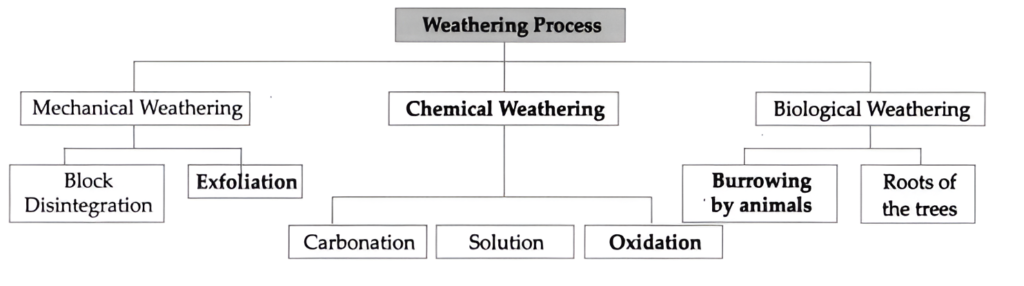
3. Complete the flowchart below.
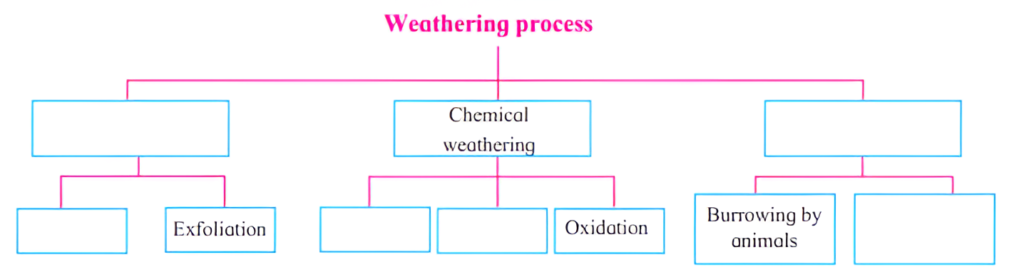
Answer.
4. Identify the type of weathering from the given description.
(a) Some animals live inside the grounds by making burrows.
Answer. Biological weathering
(b) The rock rusts.
Answer. Chemical weathering
(c) Water which has accumulated in the crevices of the rocks freezes. Consequently, the rock breaks.
Answer. Mechanical weathering
(d) The pipes supplying water in colder regions break.
Answer. Mechanical weathering
(e) Sand formation occurs in deserts.
Answer. Mechanical weathering
5. Using internet, look for incidences of a few landslides that have occurred in India and write about them briefly.
Answer.
Malin Landslide (2014):
- Occurred on July 30, 2014, in Malin village, Pune district, Maharashtra.
- Heavy rainfall triggered a mudslide, burying over 40 houses and killing 151 people.
- The steep slope and weathered soil contributed to this rapid mass movement.
Kedarnath Landslide (2013):
- Happened in June 2013 in Uttarakhand during heavy floods.
- Landslides and flash floods destroyed homes, roads, and temples, killing over 5,000 people.
- Excessive rain and unstable slopes caused the disaster.
Kerala Landslides (2018):
- Took place in August 2018 in Idukki and Wayanad districts during monsoon floods.
- Heavy rain led to landslides, killing over 400 people and displacing thousands.
- Weathered slopes and deforestation worsened the event.