
1. Rewrite the correct statement :
(1) The temperature range helps the wind in its work.
Answer.
Correct: The temperature range helps the wind in its work by causing mechanical weathering, which creates loose particles for wind to carry.
(2) River’s work is more prominent than other agents of erosion in desert regions.
Answer.
Incorrect, rewrite: Wind’s work is more prominent than other agents of erosion in desert regions.
(3) The work of groundwater is effective in the area with soft rocks.
Answer.
Correct: The work of groundwater is effective in areas with soft rocks because it can dissolve and erode them easily.
(4) The work of wind is not limited like river, glacier or the sea waves and takes place everywhere.
Answer.
Correct: The work of wind is not limited like rivers, glaciers, or sea waves and takes place everywhere, especially in open areas.

2. Correct and rewrite the incorrect statements :
(1) The ice on the lateral side of the glacier moves faster than the ice at the base.
Answer.
Incorrect, rewrite: The ice at the base of the glacier moves faster than the ice on the lateral side due to less friction.
(2) The depositional work by rivers happens because of gentle slope, reduced speed and transported sediments.
Answer.
Correct: The depositional work by rivers happens because of gentle slope, reduced speed, and transported sediments.
(3) A river flows at a faster speed than the glacier.
Answer.
Correct: A river flows at a faster speed than the glacier.
(4) The speed of the glacier is more on both the banks than in the middle.
Answer.
Incorrect, rewrite: The speed of the glacier is more in the middle than on both the banks due to less friction.
3. Identify the wrong pair :
(1) Deposition – V–shaped valley
Answer.
Wrong: V-shaped valleys are formed by erosion, not deposition.
(2) Transport – Ripple Marks
Answer.
Correct: Ripple marks are linked to the transport and deposition of sand by wind or water.
(3) Erosion – Mushroom Rocks
Answer.
Correct: Mushroom rocks are formed by the erosional work of wind.
4. Identify and name the landforms in the following diagrams :
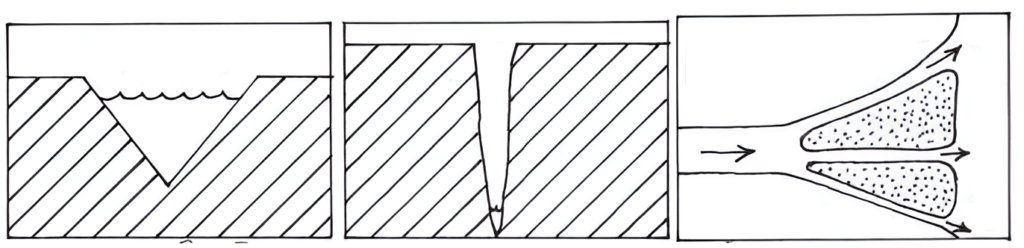
Answer.
(i) V-shaped valley, (ii) Gorge (canyon), (iii) Delta.
5. Complete the following table by classifying the landforms according to their agents of erosion.
(waterfall, delta, cirque, arête, barchans, moraine, pothole, mushroom rock, sinkholes, beach, pillars, lagoons)
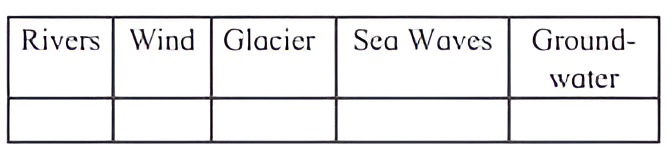
Answer.
| Rivers | Wind | Glacier | Sea waves | Ground Water |
| Waterfall | Barchans | Cirque | Beach | Sinkholes |
| Delta | Mushroom rock | Aretes | Lagoons | Pillars |
| Pothole | Moraine |
6. Answer the following questions in brief.
(1) List the landforms that are a result of the erosional work of the rivers.
Answer.
Gorges (canyons), V-shaped valleys and waterfalls are the result of the erosional work of the rivers.
(i) ‘V’ Shaped Valley:
- A ‘V shaped valley is formed due to the erosional work of a river.
- Over a period of time, the amount of load in the flow starts increasing.
- More and more energy of the river gets consumed in transporting the material.
- As a result, there is less erosion of the bed. The erosion along the banks and the slopes of the valley increases.
- Hence, the slopes recedes and the valley with near-vertical sides becomes wider, resembling the letter ‘V’.
(ii) Gorge:
- A gorge is found in the upper course of the river.
- It is a deep and narrow valley with steep sides.
- In mountainous areas, the river flows with great speed. Therefore, the bed of the river gets eroded more than its banks, giving rise to a gorge that has a steep banks and a narrow bed.
(iii) Waterfall:
- Waterfalls are formed as a result of the erosional work of a river.
- Water flowing over a hilly region cascades down a cliff, forming a waterfall.
- In the areas, where the hard and soft rocks are next to each other, the soft rocks are eroded faster than the hard ones. A difference in the height along the river bed leads to the formation of a waterfall.
(2) Which agent is responsible for formation of stalactites and stalagmites and where are they formed?
Answer.
- The work of groundwater is responsible for the formation of stalactites and stalagmites.
- In areas of limestone, the alkaline water seeps through the roof of the limestone caves.
- When this water evaporates, minerals get deposited at the bottom and at the top of the limestone caves.
- This leads to formation of stalactites and stalagmites.
(3) List the landforms that are produced by the depositional work of the sea waves.
Answer.
Answer:
The landforms like beaches, sand bar, lagoons are formed due to depositional work of the sea waves.
(i) Beach:
- Large amount of sediments come from the landward side in areas between two adjoining headlands.
- Moreover, as these areas are shallow, the velocity of the waves decreases.
- As a result, the sediments that come from the land, as well as those coming from the deep sea, get deposited in this area.
- Predominantly fine sand gets settled along the coast.
- Such sandy deposits along the coasts are called beaches.
(ii) Lagoon:
- The brackish water separated from the seawater by sand bars and lying in the areas between the coast and bars is called a lagoon.
- As the waters are separated from the open sea, large waves are not generated.
- These lagoons run parallel to the sea coast.
(iii) Sand bars:
- Sand gets deposited along the sides of the headlands.
- The deposition extends parallel to the coast from one headland to the next.
- Over a period of time, these deposits extend over long distances forming bars that protrude into the water at some distance away from the beach.
- These are known as ‘sand bars’, Sometimes, the eroded material from the’ beach, gives rise to the sand bars.
(4) Name the types of moraines.
Answer.
The glaciers carry sediments with them. These sediments are called moraines. Depending ond the location of the deposits, moraines can be divided into 4 types: ground moraines, lateral moraines, medial moraines and terminal moraines.
- The material deposited at the base of a glacier is called ground moraine.
- The material deposited along the banks of a glacier is called Lateral moraine.
- After the confluence of two glaciers, the moraine deposited in the central part of the glacier is known as medial moraine. It is formed out of . the side moraine of the inner banks of the two glaciers.
- At the end where a glacier turns into a stream, huge quantity of moraine is deposited. The stream of water is unable to carry the moraine further. As the deposited moraine is at the terminal part of a glacier, it is called terminal moraine.