
Q. 1. Choose the correct alternatives from those given below and complete the statements.
1. The muscular structure that separates the thoracic and abdominal cavity is …………………..
(a) pleura
(b) diaphragm
(c) trachea
(d) epithelium
Answer. (b) diaphragm
2. What is the minimum number of plasma membrane that oxygen has to diffuse across to pass from air in the alveolus to haemoglobin inside a R.B.C.?
(a) two
(b) three
(c) four
(d) five
Answer. (a) two
3. …………………. is a sound producing organ.
(a) Larynx
(b) Pharynx
(c) Tonsils
(d) Trachea
Answer. (a) Larynx
4. The maximum volume of gas that is inhaled during breathing in addition to T.V. is …………………..
(a) residual volume
(b) IRV
(c) GRV.
(d) vital capacity
Answer. (b) IRV
5. ……………. muscles contract when the external intercostal muscles contract
a. Internal abdominal
b. Jaw
c. Muscles in bronchial walls
d. Diaphragm
Answer. (d) Diaphragm
6. Movement of cytoplasm in unicellular organisms is called …………………..
(a) diffusion
(b) cyclosis
(c) circulation
(d) thrombosis
Answer. (b) cyclosis
7. Which of the following animals do not have closed circulation?
(a) Earthworm
(b) Rabbit
(c) Butterfly
(d) Shark
Answer. (c) Butterfly
8. Diapedesis is performed by …………………..
(a) erythrocytes
(b) thrombocytes
(c) adipocytes
(d) leucocytes
Answer. (d) leucocytes
9. Pacemaker of heart is …………………..
(a) SA node
(b) AV node
(c) His bundle
(d) Purkinje fibers
Answer. (a) SA node
10. Which of the following is without nucleus?
(a) Red blood corpuscle
(b) Neutrophil
(c) Basophil
(d) Lymphocyte
Answer. (a) Red blood corpuscle
11. Cockroach shows which kind of circulatory system?
(a) Open
(b) Closed
(c) Lymphatic
(d) Double
Answer. (a) Open
12. Diapedesis can be seen in …………………..
(a) RBCl
(b) WBC
(c) Platelet
(d) neuron
Answer. (b) WBC
13. Opening of inferior vena cava is guarded by ______.
a. bicuspid valve
b. tricuspid valve
c. Eustachian valve
d. Thebesian valve
Answer. (c) Eustachian valve
14. …………………. wave in ECG represent atrial depolarization.
(a) P
(b) QRS complex
(c) Q
(d) T
Answer. (a) P
15. The fluid seen in the intercellular spaces in Human is …………………..
(a) blood
(b) lymph
(c) interstitial fluid
(d) water
Answer. (b) lymph

Q. 2. Match the Respiratory surface to the organism in which it is found.
| Respiratory surface | Organism |
| (1) Plasma membrane | (a) Insect |
| (2) Lungs | (b) Salamander |
| (3) External gills | (c) Bird |
| (4) Internal gills | (d) Amoeba |
| (5) Trachea | (e) Fish |
Answer.
| Respiratory surface | Organism |
| (1) Plasma membrane | (d) Amoeba |
| (2) Lungs | (c) Bird |
| (3) External gills | (b) Salamander |
| (4) Internal gills | (e) Fish |
| (5) Trachea | (a) Insect |
Q. 3. Very short answer questions.
1. Why does trachea have ‘C’ shaped rings of cartilage?
Answer.
Trachea is supported by ‘C’-shaped rings of J cartilage which prevent it from collapsing and always keep it open.
2. Why is respiration in insect called direct respiration?
Answer.
Respiration in insect is called direct because tracheal tubes exchange O2 and CO2 directly with the haemocoel which then exchange them with tissues.
3. Why is gas exchange very rapid at alveolar level.
Answer.
Gas exchange is very rapid at alveolar level because numerous alveoli (about 700 millions) in the lungs provide large surface area for gaseous exchange.
4. Name the organ which prevents the following the entry of food into the trachea while eating.
Answer.
Epiglottis prevents the entry of food into trachea while eating.
Q. 4. Short answer questions.
1. Why is it advantageous to breathe through the nose than through the mouth?
Answer.
Breathing through nose is better than breathing through the mouth because of the following reasons:
- The nostrils are smaller than the mouth so air exhaled through the nose creates a backflow of air into the lungs.
- As we exhale more slowly through the nose than we do through the mouth, the lungs have more time to extract oxygen from the air that we have already taken in.
- The hairs inside nostrils filter any dust particles and microbes in the air and it only lets the clean air pass through.
- The air gets warm and humidified in nostrils as it passes into our bodies.
- Moreover breathing through the mouth can dry the oral cavity and lead to bad breath, gum disease and tooth decay.
2. Identify the incorrect statement and correct it,
a. A respiratory surface area should have a large surface area.
b. A respiratory surface area should be kept dry.
c. A respiratory surface area should be thin, may be 1mm or less.
Answer.
Statement (a) and statement (c) are correct whereas statement (b) is incorrect. A respiratory surface area should be kept moist, is the correct statement.
3. Given below are the characteristics of some modified respiratory movement. Identify them.
a. Spasmodic contraction of muscles of expiration and forceful expulsion of air through nose and mouth.
Answer.
Sneezing
b. An inspiration followed by many short convulsive expiration accompanied by facial expression.
Answer.
Laughing, Crying.
4. Write a note on blood plasma.
Answer.
- Plasma is a straw coloured, slightly alkaline viscous fluid part of the blood, having 90-92% water and 8-10% soluble proteins.
- Serum albumin, serum globulin, heparin, fibrinogen and prothrombin are the plasma proteins which form 7% of the plasma.
- Glucose, amino acids, fatty acids and glycerol are the nutrients dissolved in plasma.
- Nitrogenous wastes (urea, uric acid, . ammonia and creatinine) and respiratory gases (oxygen and carbon dioxide) is present in plasma.
- Enzymes and hormones too are transported Ada plasma.
- Inorganic minerals are also present in plasma such as bicarbonates, chlorides, phosphates and sulphates of sodium, potassium, calcium and magnesium.
5. Explain blood clotting in short.
Answer.
- The process of converting the liquid blood into a semisolid form is called blood clotting or coagulation.
- The process of clotting may be initiated by contact of blood with any foreign surface (intrinsic process) or with damaged tissue (extrinsic process).
- Intrinsic and extrinsic processes involve interaction of various substances called clotting factors by a step wise or cascade mechanism.
- There are in all twelve clotting factors numbered as I to XII (factor VI is not in active use).
- Interaction of these factors in a cascade manner leads to formation of enzyme, Thromboplastin which helps in the formation of enzyme prothrombinase.
- Prothrombinase inactivates heparin and also converts inactive prothrombin into active thrombin.
- Thrombin converts soluble blood protein- fibrinogen into insoluble fibrin. Fibrin forms a mesh in which platelets and other blood cells are trapped to form the clot.
- These reactions occur in 2 to 8 minutes. Therefore, clotting time is said to be 2 to 8 minutes.
6. Describe pericardium.
Answer.
- Pericardium is the double layered peritoneum that encloses the heart. It consists of two layers, viz. fibrous pericardium and serous pericardium.
- Fibrous pericardium is the outer layer having tough, inelastic fibrous connective tissue whereas serous pericardium is the v inner double layered membrane. It has in turn an outer parietal layer and inner visceral layer.
- Parietal layer of serous pericardium lies on the inner side of fibrous pericardium.
- Visceral layer also known as epicardium adheres to heart and thus forms outer covering over the heart.
- There is a pericardial fluid in the pericardial space which is present in between the parietal and visceral layers of serous pericardium.
7. Describe valves of human heart.
Answer.
Human heart has following main valves:
- Tricuspid valve : Tricuspid valve is present between the right atrium and right ventricle. It has three cusps or flaps. It prevents the backflow of blood into right atrium.
- Bicuspid valve : Bicuspid valve, also called mitral valve is present between the left atrium and left ventricle. It has two flaps. It prevents the backflow of blood in left atrium. Both tricuspid and bicuspid valves are attached to papillary muscles with tendinous chords or chordate tendinae to prevent valves from turning back into atria at the time of systole.
- Semilunar valve : These are present at the opening of pulmonary artery and systemic aorta. They prevent the back flow of blood when ventricles undergo systole.
- Thebesian valve : Thebesian valve is present at the opening of coronary sinus.
- Eustachian valve : Eustachian valve is present at the opening of inferior vena cava.
8. What is role of papillary muscles and chordae tendinae in human heart?
Answer.
- Papillary muscles are large and well- developed muscular ridges present along the inner surface of the ventricles.
- Bicuspid and tricuspid valves are attached to papillary muscles of ventricles by chordae tendinae.
- Chordae tendinae are inelastic fibres present in the lumen of ventricles.
- The chordae tendinae prevent the valves from turning back into the atria during the contraction of ventricles and regulate the opening and closing of bicuspid and tricuspid valves.
9. Explain in brief the factors affecting blood pressure.
Answer.
- Cardiac output : Normal cardiac output is 5 lit/min. Increase in cardiac output increases systolic pressure.
- Peripheral resistance : Peripheral resistance depends upon the diameter of blood vessels. Decrease in diameter of arterioles and capillaries under the effect of vasopressin cause increase in peripheral resistance and thereby increase in blood pressure.
- Blood volume : Loss of blood in accidents decreases blood volume and thus cause decrease in blood pressure.
- Viscosity of blood : Blood pressure is directly proportional to viscosity of blood.
- Age : Blood pressure increases with age due to increase in inelasticity of blood vessels.
- Venous return : Amount of blood brought to the heart via the veins per unit time is called the venous return and it is directly proportional to blood pressure.
- Length and diameter of blood vessels : Blood pressure is directly proportional to the total length of the blood vessel. Blood pressure can also be affected by vasoconstriction or vasodilation.
- Gender : Females have slightly lower BP than males of her age before menopause. However, the risk of high B. P increases in the females after menopause sets in.
Q. 5. Give scientific reason.
1. Closed circulation is more efficient than open circulation.
Answer.
- Closed circulation considerably enhances the speed, precision and efficiency of circulation.
- The blood flows more rapidly, it takes less time to circulate through the closed system and return to the heart.
- This fastens the supply and removed of materials to and from the tissues by the blood as compared to open circulation.
- In open circulation, there are no blood vessels such as arteries or veins, to pump the blood.
- Therefore, the blood pressure is very low.
- Organisms with an open circulatory system typically have a relatively high volume of hemolymph and low blood pressure. Closed circulation is thus more efficient than open circulation.
2. Human heart is called as myogenic and autorhythmic.
Answer.
- The heart shows auto rhythmicity because the impulse for its rhythmic movement develops inside the heart. Such heart is called myogenic.
- Some of the cardiac muscle fibres become auto rhythmic (self-excitable) and start generating impulse during development.
- These autorhythmic fibres perform two important function, viz. acting as a pacemaker and setting the rhythm for heart.
- They also form conducting system for conduction of nerve impulses throughout the heart muscles.
3. Person who has undergone heart transplant needs lifetime supply of immunosupressants.
Answer.
a. Immunosuppressants are the drugs that reduce the level of immune activity and the risk of rejection of foreign bodies such as transplant organs.
b. After transplantation, there is a risk of graft rejection as the body may recognize the transplanted organ/tissue as foreign and may trigger an immune response thereby damaging the transplanted organ. Therefore, the heart recipient has to rely upon lifetime supply of immunosuppressants.
4. Arteries are thicker than veins.
Answer.
- Arteries have relatively thick walls to enable them to withstand the high pressure of blood ejected from the heart.
- Arteries expand when the pressure increases as the heart pushes blood out but then recoil (shrink) Wn the pressure decreases when the heart relaxes between heartbeats.
- This expansion and recoiling occurs to maintain a smooth blood flow.
- Veins, on the other hand, have thinner walls and larger lumen veins have no need for thick walls as then need not have to withstand high pressure like arteries.
- Moreover, as veins transport relatively low pressure blood, they are commonly equipped with valves to promote the unidirectional flow of blood towards the heart.
5. Left ventricle is thick than all other chambers of heart.
Answer.
- Left ventricle pumps oxygenated blood to all parts of the body. Therefore, there is greater pressure from the blood in left ventricle.
- Right ventricle sends deoxygenated blood to lungs for oxygenation. This does not put more pressure and lungs are in vicinity of the heart.
- Due to these functional differences between the two ventricles, left ventricle has thicker wall than that of the right ventricle.
Q. 6. Distinguish between :
1. Open and closed circulation.
Answer.
| Open circulation | Closed circulation |
| 1. In open circulation, blood flows through large open spaces and channels called lacunae and haemocoels among the tissues. | 1. In closed circulation, blood flows through a network of blood vessels all over the body. |
| 2. Tissues are in direct contact with the blood. | 2. Blood does not come in direct contact with tissue. |
| 3. Blood flows with low pressure and usually does not contain any respiratory pigment like haemoglobin. | 3. Blood flows with high pressure and contains respiratory pigment like haemoglobin. |
| 4. Exchange of material takes place directly between blood and cells or tissues of the body. | 4. Exchange of material takes place between blood and body tissues through an intermediate fluid called lymph. |
| 5. Volume of blood flowing through a tissue cannot be controlled as blood flows out in open space. | 5. Volume of blood can be regulated by the contraction and relaxation of the smooth muscles of the blood vessels. |
| 6. Open circulatory system is found in arthropods and some molluscs. | 6. Closed circulatory system is found in annelids, echinoderms and all vertebrates. |
2. Artery and vein.
Answer.
| Arteries | Veins |
| 1. The blood vessels that arise from the heart and carry blood away from heart are called arteries. | 1. The blood vessels that bring blood to the heart are called veins. |
| 2. Arteries are thick walled blood vessels, situated in deep layers in the body. | 2. Veins cure thin walled blood vessels, situated superficially in the body. |
| 3. Arteries do not have valves. | 3. Veins have valves. |
| 4. Tunica adventitia, the outermost layer of arteries is thick and elastic. | 4. Tunica externa, the outermost layer of veins is thin. |
| 5. Tunica media is very thick and contain elastic fibres. | 5. Tunica media is thin layer and contain involuntary muscle fibres. |
| 6. The lumen of arteries is small. | 6. The lumen of the veins is very spacious. |
| 7. With the exception of pulmonary arteries, all other arteries carry oxygenated blood. | 7. With the exception of pulmonary veins, all other veins carry deoxygenated blood. |
| 8. Blood in the arteries show high blood pressure. | 8. Blood in the veins show lesser blood pressure. |
3. Blood and lymph.
Answer.
| Blood | Lymph |
| 1. Contains blood plasma with proteins and all three types of blood cells namely RBCs, WBCs and blood platelets. | 1. Contains blood plasma without blood proteins, RBCs and platelets and contains lymphocytes. |
| 2. Red in colour due to presence of RBCs. | 2. Light yellow in colour and does not contain RBCs. |
| 3. Carries oxygen in the body. | 3. Does not carry oxygen. |
| 4. The flow of blood in blood vessels is fast. | 4. The flow of lymph in lymph capillaries is slow. |
| 5. Lymphocytes are present. | 5. Lymphocytes are present, more in number than those present in the blood. |
4. Blood capillary and lymph capillary.
Answer.
| Blood capillary | Lymph capillary |
| 1. Reddish, easy to observe. | 1. Colourless, difficult to observe. |
| 2. Joined to arterioles at one end and to venules at another end. | 2. Blind (closed at the tip). |
| 3. Narrower than lymph capillaries. | 3. Wider than blood capillaries. |
| 4. Wall consists of normal endothelium and basement membrane. | 4. Wall consists of thin endothelium and poorly developed basement membrane. |
| 5. Contains red blood. | 5. Contains colourless lymph. |
| 6. Have relatively high pressure. | 6. Have relatively low pressure. |
5. Intrinsic and extrinsic process of clotting.
Answer.
| Intrinsic process | Extrinsic process |
| 1. The intrinsic pathway requires only clotting factors found within the blood itself – in particular, clotting factor XII (Hageman factor) from the platelets. | 1. The extrinsic pathway is initiated by factors external to the blood, in the tissues adjacent to damaged blood vessel – in particular, it is initiated by clotting factor III, thromoboplastin from the damaged tissues. |
| 2. It is a longer, multistep process and it takes a little longer for the blood to clot by this mechanism. | 2. It involves fewer chemical reaction steps and produce a clot a little more quickly than the intrinsic pathway. |
Q. 7. Long answer questions.
1. Smita was working in a garage with the doors closed and automobiles engine running. After some time she felt breathless and fainted. What would be the reason? How can she be treated?
Answer.
- As Smita and John were working with the car engine running in a closed garage, they must be suffering from carbon monoxide poisoning.
- Carbon monoxide (CO) is a highly toxic gas produced when fuels burn incompletely from automobile engines.
- Because of strong affinity of haemoglobin with carbon monoxide, it readily combines with carbon monoxide to from a stable compound, carboxyhaemoglobin. Thus, less haemoglobin is available for oxygen transport depriving the cells of oxygen.
- Exposure to carbon monoxide can usually leads to throbbing headache, drowsiness, breathlessness and often person gets fainted. In extreme cases carbon monoxide poisoning usually leads to unconsciousness, convulsions, cardiovascular failure, coma and eventually death.
The breathless persons can be treated by following method:
- Oxygen treatment : The best way to treat carbon monoxide poisoning is to breathe in pure oxygen (high-dose oxygen treatment)
- Oxygen chamber : Doctor may temporarily place her in a pressurized oxygen chamber (also known as a hyperbaric oxygen chamber)
2. Shreyas went to a garden on a wintry morning. When he came back, he found it difficult to breath and started wheezing. What could be the possible condition and how can he be treated ?
Answer.
(1) It indicates that Shreyas might be suffering from allergic reactions. He may have come in contact with allergens such as pollen, dust, pet dander or other environmental substances on his way in the garden. Or Shreyas may be already a patient of Asthma and his symptoms may have aggrevated due to wintry climate.
(2) If a person is allergic to a substance, such as pollen, his immune system reacts to the substance as if it was foreign and harmful, and tries to destroy it.
(3) The body reacts to these allergens by making and releasing substances known as IgE antibodies. These IgE antibodies attach to most cells in the body which release histamine. Histamine is the main substance responsible for pollen allergy symptoms such as difficulty in breathing, wheezing, sneezing, itchy throat, etc.
(4) Treatment : There are several drugs to treat the allergic reactions:
- Antihistamines such as cetirizine or diphenhydramine.
- Decongestants, such as pseudoephedrine or oxymetazoline.
- Medications that combine an antihistamine and decongestant such as Actifed and Claritin-D.
3. Why can you feel a pulse when you keep a finger on the wrist or neck but not when you keep them on a vein?
Answer.
(1) When the heart contracts, it creates pressure that pushes blood out of heart. This pressure acts like a wave. This “wave” of pressure is the pulse you feel. But this pressure is not constant.
(2) When the heart pumps the blood out of it at the time of systole, there is maximum pressure in the arteries. This pressure weakens considerably when it reaches capillaries, and so the veins which are away from the heart are under less pressure. Due to low pressure veins have valves to prevent backflow of blood.
(3) The pressure in the arteries can be felt every time the heart beats, especially in arteries which come to surface of the body like that of the wrist and neck but not in veins.
(4) The pressure in veins is always weaker than in arteries, resulting in a weaker pulse to the point that it is undetectable by touch
alone.
(5) Owing to this, when we keep finger on the arteries of wrist or neck, we feel a pulse but not when we keep it on a vein.
4. A man’s pulse rate is 68 and cardiac output is 5500 cm³. Find the stroke volume.
Answer.
Cardiac output is the volume of blood pumped out per min for a normal adult human being it is calculated as follows:
Cardiac output = Heart rate × Stroke volume
Given : Cardiac output = 5500 cm³
Pulse rate = Heart rate = 68
By using these values stroke volume of is calculated as follows:
∴ Cardiac output = Heart rate × Stroke volume
∴ Stroke volume = Cardiac output/Heart rate
= 5500/68
= Approx. 80. ∴ Stroke volume is 80 ml.
5. Which blood vessel of the heart will have the maximum content of Oxygen and why?
Answer.
- The Aorta leaving the heart from left ventricle carry the maximum content of oxygen.
- Deoxygenated blood becomes oxygenated in the pulmonary capillaries surrounding the alveoli of lungs. The oxygenated blood from lungs is collected by the four pulmonary veins.
- These pulmonary veins carry that oxygenated blood to left atrium of heart. During atrial systole that blood is carried to left ventricle.
- Left ventricle then pumps that oxygenated blood to Aorta during ventricular systole. Therefore, aorta has the maximum content of oxygen.
6. If the duration of the atrial systole is 0.1 sec and that of complete diastole is 0.4 sec, then how does one cardiac cycle complete in 0.8 sec?
Answer.
- The time duration required to complete one cardiac cycle is 0.8 second.
- Cardiac cycle is divided into three important phases, viz, atrial systole, ventricular systole and joint diastole.
- Atrial systole in normal condition lasts for 0.1 second, ventricular systole follows atrial systole and lasts for 0.3 second whereas joint diastole or complete diastole lasts for about 0.4 second.
- In this way one cardiac cycle is completed in 0.8 second.
7. How is blood kept moving in the large veins of the legs?
Answer.
1. When heart undergoes systole, it pushes the blood with pressure in aorta. This pressure moves the entire circulation of the blood throughout the body. Aorta gives rise to dorsal aorta after supplying to upper parts of body. Then it divides into two arteries which enter two legs. The blood is forced to move in the legs due to blood pressure and also aided by gravity.
2. In addition, the muscles in legs help transport blood back to our heart. As the muscles of our body contract and relax to move our limbs, they squeeze the blood in veins and the blood is then pushed towards the heart.
3. The veins in legs also have valves to keep this process going and prevent blood from flowing back down towards the feet.
4. In this way blood is kept moving in the large veins of the legs.
8. Describe histological structure of artery, vein and capillary.
Answer.
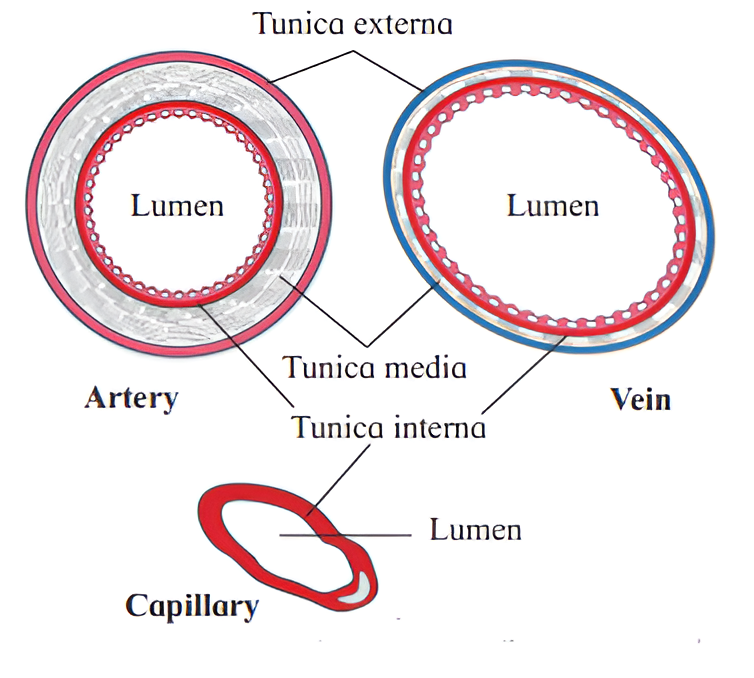
Histological structure of artery and vein.
- Artery is a thick walled blood vessel that carries oxygenated blood. (Exception is pulmonary artery which carries deoxygenated blood from heart to lungs for oxygenation.)
- All the arteries arise from heart and carry blood away from the heart.
- Each artery is made up of three layers, viz. tunica externa, tunica media and tunica interna.
- Tunica externa or adventitia is the thickest layer of all. It is the outermost coat made up of connective tissue with elastic and collagen fibres.
- Tunica media is the middle coat made up of smooth muscle fibres and elastic fibres. It withstands high blood pressure during ventricular systole. It is also thick.
- Tunica interna or intima is the innermost coat made of endothelium and elastic layer.
Histology of Capillaries:
- Capillaries are the smallest and thinnest blood vessels. Capillaries are formed by the division and re-division of the arterioles.
- The wall of the capillary is made up of endothelium or squamous epithelium.
- The capillary wall is permeable to water and dissolved substances.
- Exchange of respiratory gases, nutrients, excretory products, etc. takes place through the capillary wall.
- Capillaries unite to form venules.
9. What is blood pressure? How is it measured? Explain factors affecting blood pressure.
Answer.
10. Describe human blood and give its functions.
Answer.
(1) Composition of blood : Blood is red coloured fluid connective tissue derived from embryonic mesoderm. It is slightly alkaline (pH 7.4), salty, viscous fluid and heavier than water. It has two components – fluid plasma (55%) and formed elements (RBCs, WBCs and platelets) (44%).
(2) Plasma : It is straw coloured, slightly alkaline, viscous fluid. It contains 90% water and 10% solutes such as proteins, nutrients, nitrogenous waste, salts, hormones, etc.
(3) Red Blood Corpuscles or Erythrocytes : RBCs are circular, biconcave, enucleated cells containing respiratory pigment called haemoglobin.
(4) White Blood Corpuscles or Leucocytes : WBCs are colourless, nucleated, amoeboid and phagocytic cells. WBCs are mainly of two types, viz. granulocytes (neutrophils, basophils, eosinophils) and agranulocytes (lymphocytes, monocytes).
(5) Thrombocytes/Platelets : Platelets are very small, non-nucleated, oval shaped cells.
(6)Functions of blood :
(a) Plasma of blood transports proteins, nutrients, nitrogenous waste, salts, hormones, etc. throughout the body.
(b) RBCs transport oxygen from lungs to tissues and carbon dioxide from tissues to lungs.
(c) RBCs maintain the blood pH as haemoglobin acts as a buffer.
(d) RBCs also maintain viscosity of blood.
(e) Platelets contain thromboplastin which helps in clotting of blood.
(f) Basophils release heparin which acts as an anticoagulant and histamine that is involved in inflammatory and allergic reactions.
(g) Neutrophils and monocytes are phagocytic in function and engulf microorganisms. Thus provide defence against infection.
(h) Lymphocytes are responsible for immune response of the body by producing antibodies.
Functions of blood:
- Transport of oxygen and carbon dioxide
- Transport of food
- Transport of waste product
- Transport of hormones
- Maintenance of pH
- Water balance
- Transport of heat
- Defence against infection
- Temperature regulation
- Blood clotting/coagulation
- Helps in healing