Classification of Plants Class 9 Science Chapter 6 Questions And Answers Maharashtra Board
16 February 2026 EasyLearning
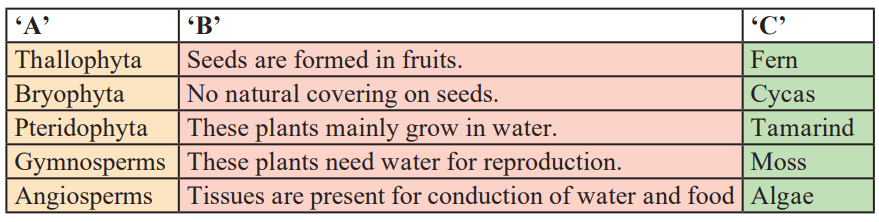
1. Match the proper terms from columns A and C with the description in column B.
Answer.
| Group (A) | Description (B) | Example (C) |
| Thallophyta | These plants mainly grow in water. | Algae |
| Bryophyta | These plants need water for reproduction (Amphibians of the plant kingdom). | Moss |
| Pteridophyta | Tissues are present for conduction of water and food (Vascular plants without seeds). | Fern |
| Gymnosperms | No natural covering on seeds (Naked seeds). | Cycas |
| Angiosperms | Seeds are formed in fruits (Flowering plants). | Tamarind |

2. Complete the sentences by filling in the blanks and explain those statements.
(angiosperms, gymnosperms, spore, bryophyta, thallophyta, zygote)
a. ……………….. plants have soft and fibre-like body.
b. ……………….. is called the ‘amphibian’ of the plant kingdom.
c. In pteridophytes, asexual reproduction occurs by ……………….. formation and sexual reproduction occurs by ………………..formation.
d. Male and female flowers of ………………..are borne on different sporophylls of the same plant.
Answer.
(a) Thallophyta.
Reason :
Thallophyta includes algae which have soft and fibre like body.
(b) Bryophyta.
Reason :
Plants belonging to Bryophyta grow on moist soil, but need water for reproduction. Since they share two habitats, such as soil and water, they are called amphibians.
(c) Spores, gametes.
Reason :
Pteridophytes reproduce by spores, which are formed along the posterior or back surface of the leaves. Sexual reproduction is always by formation of
male and female gametes.
(d) Gymnosperms.
Reasons :
Only in gymnosperms male and female flowers are borne on different sporophylls of the same plant.
3.Answer the following questions in your own words.
a. Write the charateristics of subkingdom Phanerogams.
Answer.
(1) Plants that bear seeds are called Phanerogams.
(2) In these plants, seeds are formed after reproduction.
(3) The seeds contain embryo and stored food.
(4) The stored food is used during germination for the growth of the embryo.
(5) Phanerogams are divided into two groups, viz gymnosperms and angiosperms depending upon whether the seeds are enclosed in a fruit or not.
b. Distinguish between monocots and dicots.
Answer.
| Dicots | Monocots | |
| Seed | Two cotyledons | Single cotyledon |
| Root | Well developed, primary root (Taproot) | Fibrous roots |
| Stem | Strong, hard. e.g. Banyan tree | Hollow, e.g. Bamboo False, e.g. Banana Disc-like, e.g. Onion. |
| Leaf | Reticulate venation | Parallel venation |
| Flower | Flowers with 4 or 5 parts or in their multiples (tetramerous or pentamerous) | Flowers with 3 parts or in multiples of three (trimerous). |
c. Write a paragraph in your own words about the ornamental plants called ferns.
Answer.
Ferns are ornamental plants seen in gardens.They are called ornamentals as they beautify the place wherever they grow. Since they are grown in gardens they do not bear flowers and fruits, but they bear different types of attractive leaves. They reproduce by spores which develop on the lower side of their leaflets in the form of sori ( singular – sorus )
d. Sketch, label and describe the Spirogyra.
Answer.
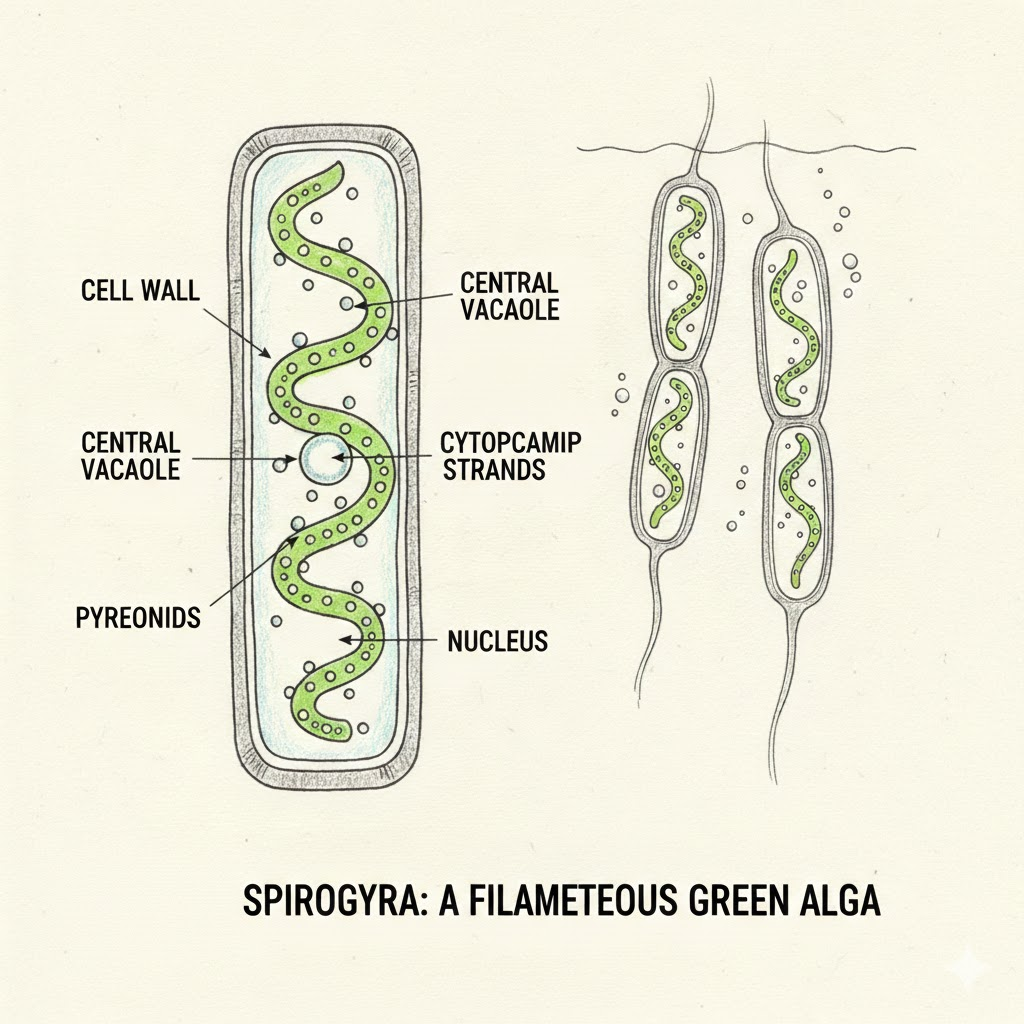
(1) Spirogyra is a green filamentous alga belonging to the division Thallophyta.
(2) It grows in fresh water.
(3) Owing to the presence of chlorophyll, it synthesises its food by the process of photosynthesis.
(4) It contains spirally arranged thread like chloroplasts in its cells.
(5) In each chloroplast, there are a number of rounded bodies surrounded by starch. These rounded bodies are called pyrenoids.
e. Write the characteristics of the plants belonging to division Bryophyta.
Answer.
(1) Plants belonging to the division Bryophyta are called amphibious plants as they grow in moist soil, but need water for reproduction, thus sharing two habitats.
(2) Plants are mostly thalloid ( Exception – Mosses ), multicellular and autotrophic.
(3) The plant body of bryophytes is flat and ribbon like without true roots. Instead of roots they possess rhizoids.
(4) They do not possess conducting tissues for the conduction of food and water.
(5) Examples : Riccia, Marchantia, Anthoceros, Funaria, etc.
4. Sketch and label the figures of the following plants and explain them into brief.
Marchantia, Funaria, Fern, Spirogyra.
Answer.
(a) Spirogyra
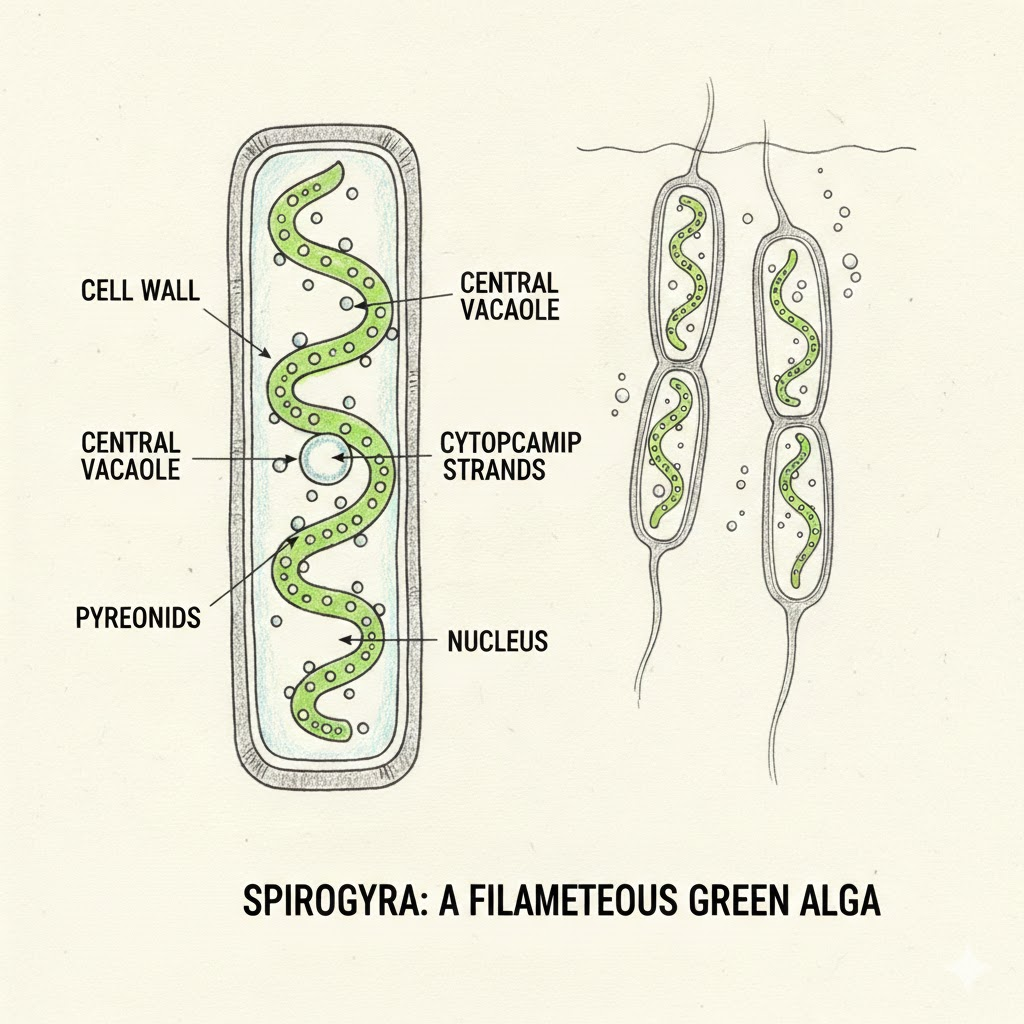
- Spirogyra is a green filamentous alga belonging to the division Thallophyta.
- It grows in fresh water.
- Owing to the presence of chlorophyll, it synthesises its food by the process of photosynthesis.
- It contains spirally arranged thread like chloroplasts in its cells.
- In each chloroplast, there are a number of rounded bodies surrounded by starch. These rounded bodies are called pyrenoids.
(b) Marchantia
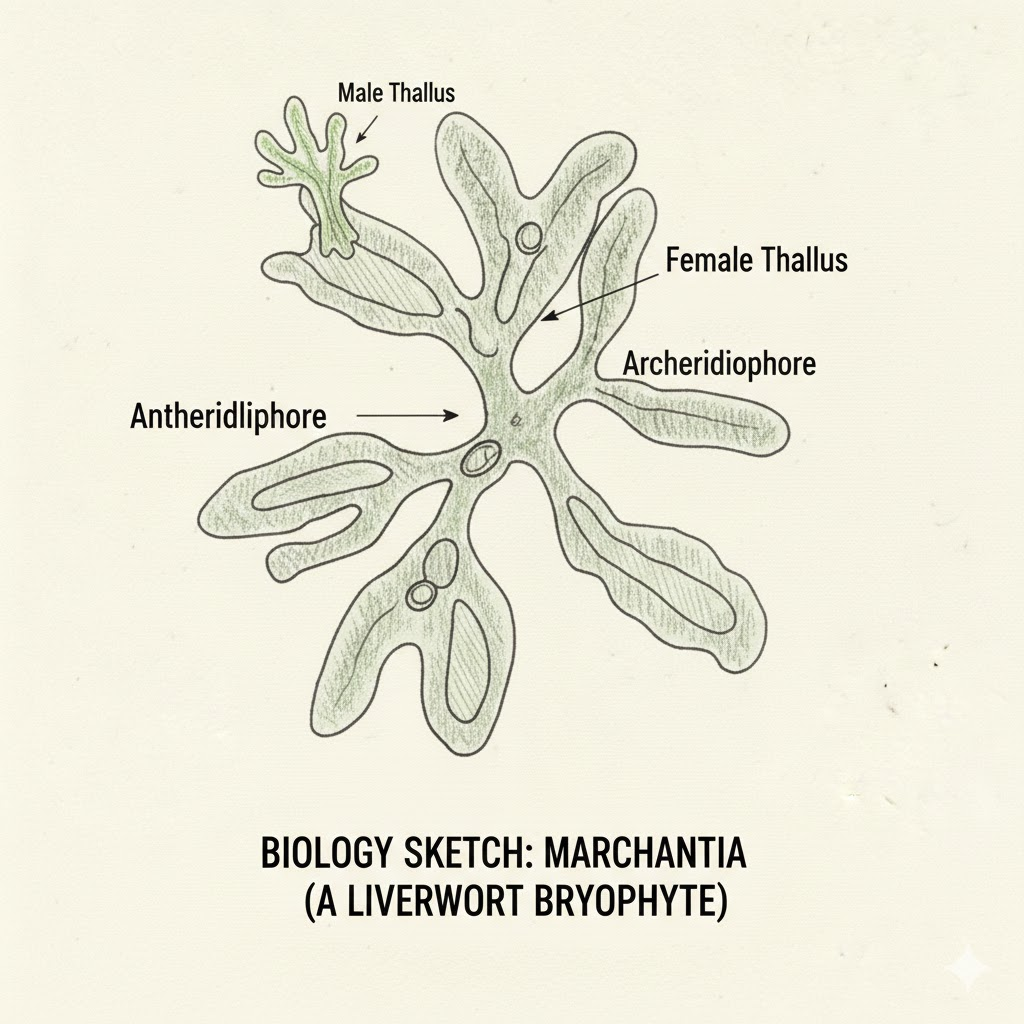
- Marchantia is a bryophyte.
- Marchantia is called amphibious plant, as it shares two habitats, viz, soil for its growth and water for reproduction.
- It is flat ribbon-like long and without true roots, stem and leaves.
- Instead of roots, it bears rhizoids.
- It lacks conducting tissues which conduct food and water.
(c) Funaria
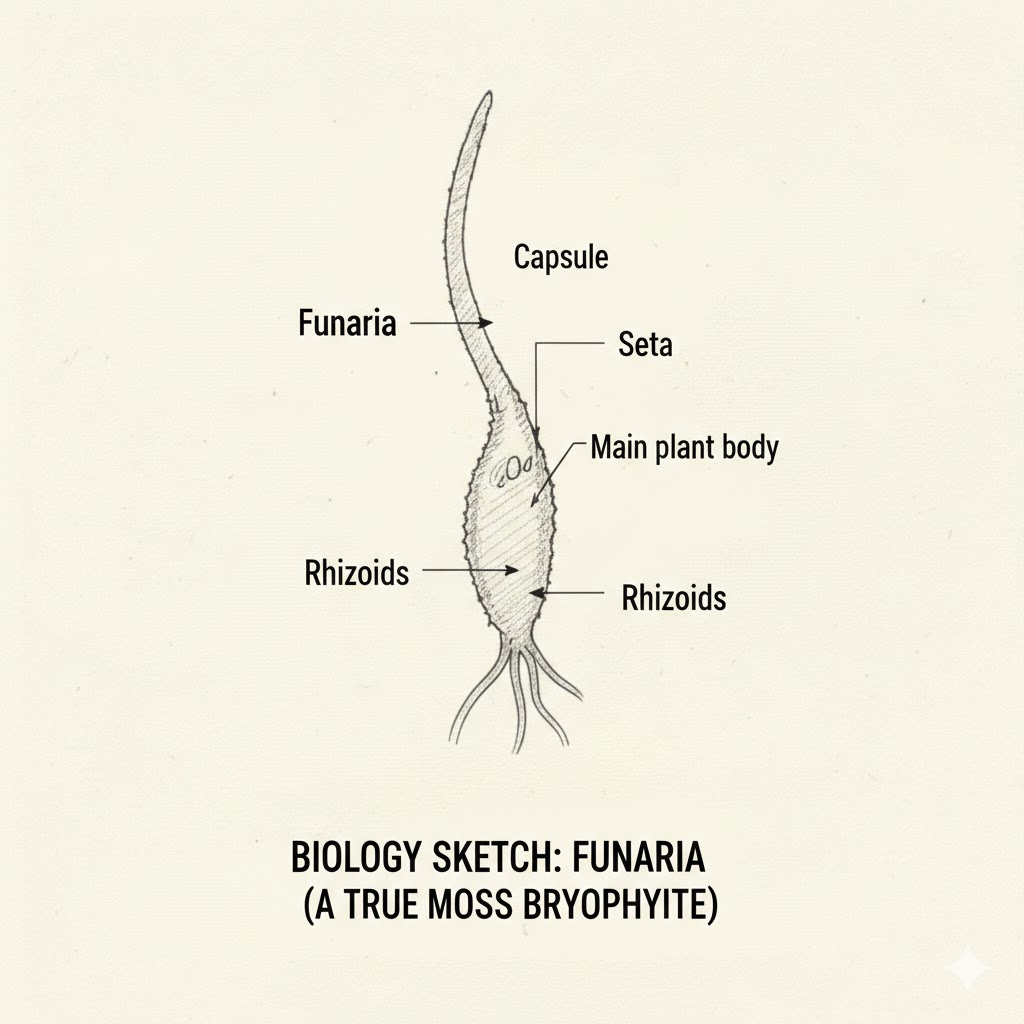
- Funaria is a bryophyte.
- Funaria is an amphibious plant.
- The plant body of Funaria is differentiated into stem-like parts, leaf-like parts and root-like rhizoids.
- It develops a capsule on a stalk during favourable conditions.
- Spores are formed inside the capsule. The spores give rise to new plants.
(d) Fern
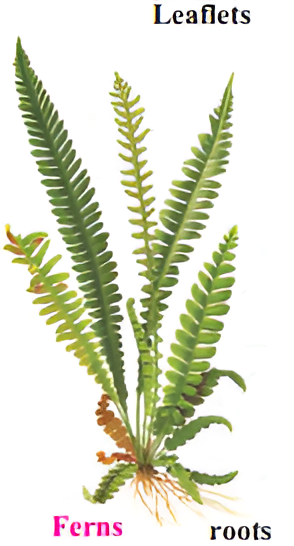
- They have well-developed roots, stem and leaves for the conduction of food and water.
- They do not bear flowers and fruits.
- They reproduce with the help of spores present along the back or posterior surface of the leaves.
5. Collect a monocot and dicot plant available in your area. Observe the plants carefully and describe them in scientific language.
Answer.
1. Onion (Allium cepa) — Monocot
- Type: It is a monocotyledon, meaning the seed has one cotyledon.
- Roots: It possesses a fibrous root system where a cluster of thin roots grows from the base.
- Venation: The leaves show parallel venation, with veins running straight and side-by-side.
- Stem: The real stem is a small, reduced disc-like structure at the base of the bulb.
- Flowers: Flower parts are trimerous (occurring in multiples of three).
- Secondary Growth: No cambium is present, so the stem does not increase in thickness.
2. Hibiscus (Hibiscus rosa-sinensis) — Dicot
- Type: It is a dicotyledon, meaning the seed has two cotyledons.
- Roots: It has a taproot system consisting of one main primary root and lateral branches.
- Venation: The leaves exhibit reticulate (net-like) venation.
- Stem: The stem is woody and branched.
- Flowers: Flower parts are pentamerous (occurring in multiples of five).
- Secondary Growth: A cambium layer is present, allowing the stem to increase in diameter.
6. Which criteria are used for the classification of plants? Explain with reasons.
Answer.
The following criteria are used for the classification of plants :
(1) There are two subkingdoms of flowering plants, viz., gymnosperms and angiosperms. If plants do not bear flowers, fruits and seeds, they are non-seed-bearing plants. Contrary to this, if they bear flowers, fruits and seeds, they are seed-bearing plants.
(2) Plants that are not differentiated into organs like roots, stem, leaves are called Thallophyta.
(3) Another criterion for classification of plants is the presence or absence of conducting tissues. Plants such as pteridophytes, gymnosperms and
angiosperms which possess conducting tissues are included under vascular plants, while bryophytes and thallophytes which do not possess vascular
tissues are included under non-vascular plants.
(4) Plants are classified into two groups, viz, seed bearing and non-seed-bearing plants depending upon the presence or absence of seeds.
(5) Depending upon whether the seeds are enclosed in fruits or not, plants have been classified as gymnosperms and angiosperms.
(6) Depending upon the number of cotyledons in seeds, plants have been classified into dicotyledons and monocotyledons.